I. Ijjaali et al. / Journal of Alloys and Compounds 354 (2003) 115–119
117
˚
distance at 2.451(2) A; the analogous distances from atom
˚
Te(2) are 1.870(2), 1.883(2), 1.885(2), and 2.714(2) A. As
shown in Table 4, these Te–O distances are comparable to
those found in Nd2Te4O11 [9] and Ho2Te4O11 [10] when
the lanthanide contraction is taken into account. By sharing
2
`
62
11
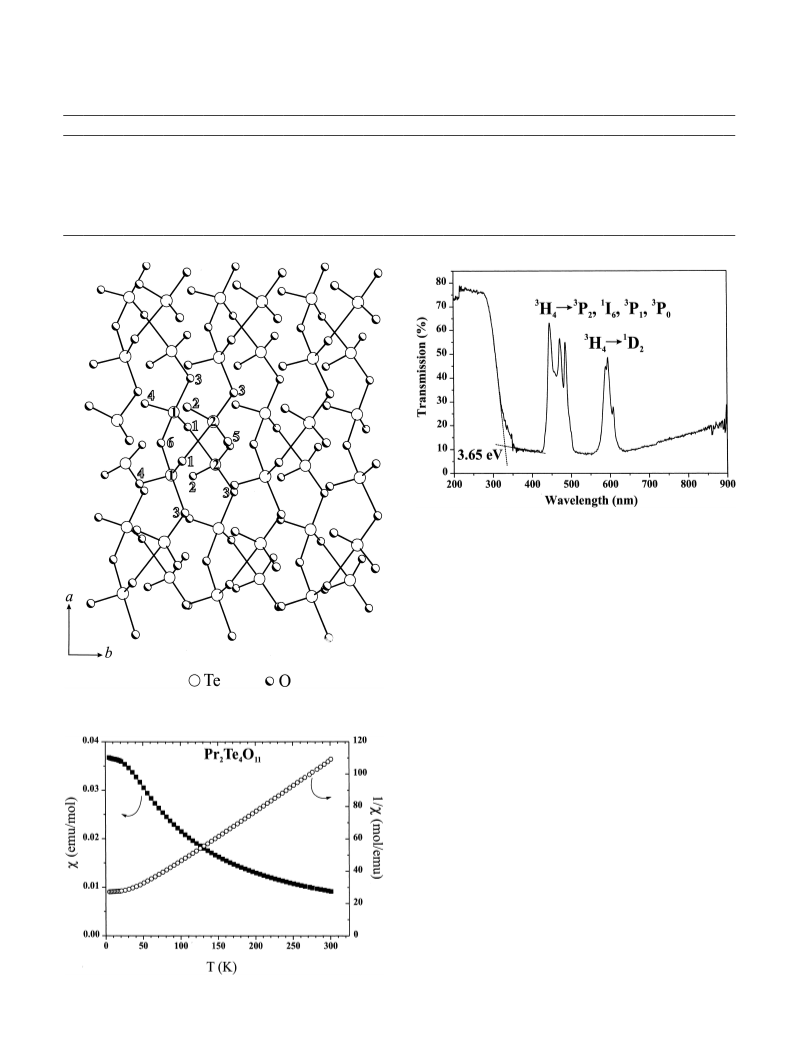
O corners, the TeO4 polyhedra link to generate [Te4O
]
layers parallel to the (a,b) plane (Fig. 3). These layers
2
142
connect through corners to the [Pr2O ] network to form
`
10
the three-dimensional structure.
To interpret the Te coordination, the bond valence
model [17–19] can be applied. When only the three short
Te–O interactions are considered, bond valences of 3.71
e2 for Te(1) and 3.91 e2 for Te(2) result. If the fourth
distance is taken into account, then the bond valences are
3.99 e2 and 4.05 e2, in good agreement with that expected
for Te(IV) and with the values of 3.97 and 3.92 e2
calculated previously for Nd2Te4O11 [9].
The magnetic susceptibility and the reciprocal suscep-
tibility as a function of temperature for Pr2Te4O11 are
shown in Fig. 4. The compound shows Curie–Weiss
paramagnetism over the temperature range 90–300 K, with
x 5 x0 1 C/(T 2up) where x0 55.47.1025 emu mol21
,
C53.23(1) emu K21 mol21, and up 5215.2(2) K. The
effective magnetic moment per Pr(III) cation obtained
from the Curie constant C is 3.59(2) mB, in excellent
agreement with the theoretical value of 3.58 mB [20]. The
deviation from Curie–Weiss behavior at low temperature
reflects the splitting of the ground state under the crystal
field effect [20]. The negative value of the paramagnetic
temperature up is probably indicative of non-cooperative
magnetic interactions [21–23]; to verify this would require
a low-temperature neutron diffraction study.
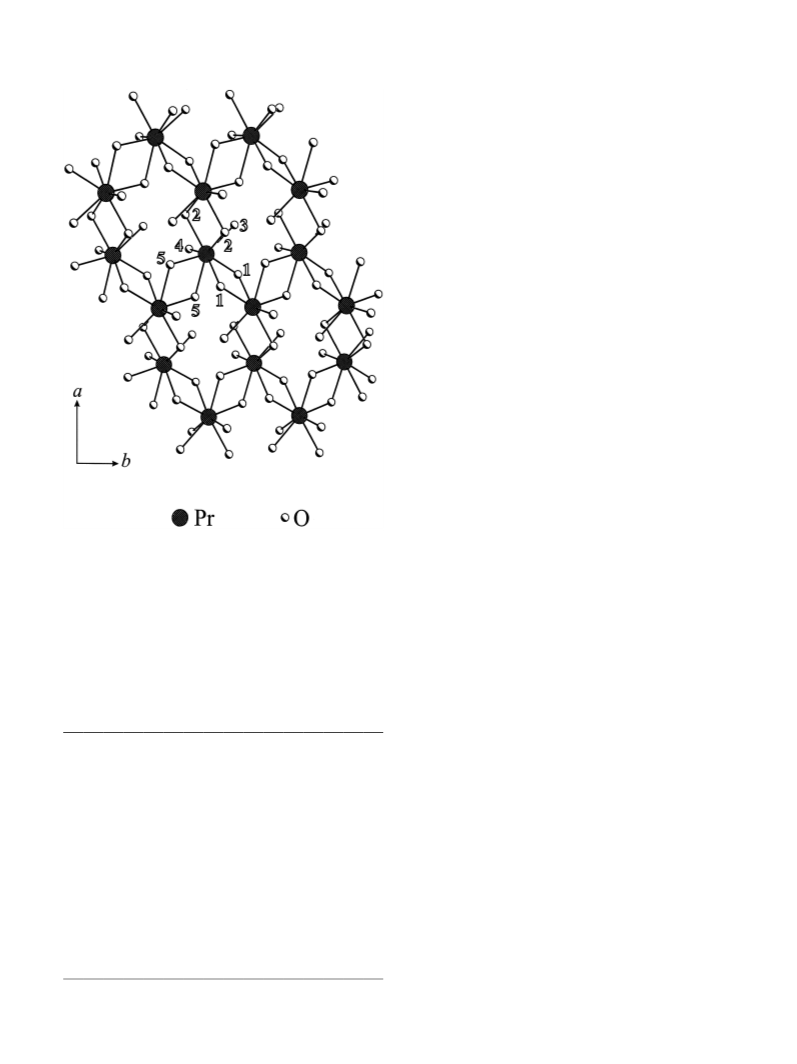
Fig. 2. View down [001] of the 2`[Pr2O142] network in Pr2Te4O11
.
10
polyhedra. The Pr–O distances range from 2.375(2) to
˚
The absorption spectrum of Pr2Te4O11 (Fig. 5) shows a
complex structure of sharp and well-resolved peaks be-
tween 420 and 520 nm. These bands originate from 4f–4f
2.615(2) A (Table 3). These agree well with literature
˚
values, i.e. 2.418–2.628 A in PrPO4 [15] and 2.341–2.652
˚
A in Pr2W2O9 [16].
3
3
transitions of the H4 ground state to the P0, 3P1, 1I6, and
Atom Te(1) is coordinated to three O atoms at distances
3
˚
of 1.834(2), 1.886(2), and 1.992(1) A, with a longer
3P2 excited states. The most intense transition is P2 →3H4.
These transitions are responsible for the green color
observed in Pr(III) compounds [24,25], whereas the
1D2 →3H4 transition around 600 nm has no influence on
the color. In addition to these narrow spectral lines that
arise from the f–f transitions of Pr(III), an optical absorp-
tion threshold at |340 nm is observed. This corresponds to
3.65 eV, as deduced by means of a straightforward extrapo-
lation method [26]. Comparable band gaps were recently
found in the hydrothermally synthesized compounds
M2Te3O8 (M5Co: 3.60 eV; Ni: 3.84 eV; Cu: 2.64 eV)
[27]. Wide band-gap semiconductors have attracted sub-
stantial interest for applications in solid-state electronics
and optics [28–31].
Table 3
˚
Selected interatomic distances (A) and angles (8) for Pr2Te4O11
Pr–O(4)
Pr–O(5)
Pr–O(2)
Pr–O(2)
Pr–O(1)
Pr–O(3)
Pr–O(5)
Pr–O(1)
1.834(2)
1.886(2)
1.992(1)
2.451(2)
103.36(8)
91.36(9)
95.75(6)
89.17(7)
77.63(7)
173.29(5)
2.375(2)
2.385(2)
2.401(2)
2.425(2)
2.505(2)
2.509(2)
2.574(2)
2.615(2)
Te(2)–O(5)
Te(2)–O(2)
Te(2)–O(3)
Te(2)–O(1)
O(5)–Te(2)–O(2)
O(5)–Te(2)–O(3)
O(2)–Te(2)–O(3)
O(5)–Te(2)–O(1)
O(2)–Te(2)–O(1)
O(3)–Te(2)–O(1)
Te(1)–O(4)
Te(1)–O(1)
Te(1)–O(6)
Te(1)–O(3)
O(4)–Te(1)–O(1)
O(4)–Te(1)–O(6)
O(1)–Te(1)–O(6)
O(4)–Te(1)–O(3)
O(1)–Te(1)–O(3)
O(6)–Te(1)–O(3)
1.870(2)
1.883(2)
1.885(2)
2.714(2)
97.09(8)
102.77(8)
98.52(8)
73.08(7)
74.56(7)
171.13(7)
Acknowledgements
This research was supported by the U.S. National
Science Foundation under Grant DMR00-96676. Use was

 Ijjaali, Ismail