N. Mkhize, et al.
CatalysisTodayxxx(xxxx)xxx–xxx
require some additional processes in order to remove excess disin-
fectant from water but higher doses of ozone can be used [12].
Ozone is a powerful oxidant that has been increasingly drawing
attention as an alternative oxidant because of its strong capability to
degrade hydrocarbons even at low temperature [13,14]. Ozonation
reaction involves the direct molecular reactions of ozone with the
compounds dissolved and involves the transformation of ozone into
secondary oxidants like hydroperoxyl radicals and hydroxyl radicals
[11]. Ozonation alone lead to partial mineralization, contrast to this
catalytic ozonation can be used due to its higher effectiveness in the
degradation of organics [15,16]. Catalytic ozonation is divided into
homogeneous catalytic ozonation and heterogeneous catalytic ozona-
tion [17]. In homogenous catalytic ozonation, the decomposition of
molecular ozone is catalyzed by the transition metal ions and this
process has disadvantages, for example, it results in reaction products
that are very hard to separate and the process is less active [16].
In heterogeneous catalytic ozonation, ozone decomposition is cat-
alyzed by metals on metal oxides as supports or metal oxides. In recent
years, heterogeneous catalytic process has been receiving an increasing
attention because of its high potential effectiveness in the oxidation as
well as in the mineralization of stubborn organic pollutants [18]. There
are various metal oxide catalysts that have been used in the hetero-
geneous catalytic ozonation and now they are developed because of
their catalytic durability as well as their catalytic performance [19].
Among the catalysts that have been used, alumina has been successfully
used in the ozonation of pollutants. Thus V2O5/Al2O3, V2O5/SiO2,
V2O5/TiO2, CuCO3/Fe2O3 and so on. Vanadium loaded on titania that is
prepared by using sol-gel method showed selectivity and stability that
are very high for oxidation of orthodichlorobenzene but vanadium
oxide was toxic, however it leads to the formation of secondary pollu-
The oxidation reactions where V2O5/Al2O3, V2O5/SiO2, V2O5/TiO2
were used as catalysts showed high selectivity (98 %–100 %) but little
mineralisation [8]. There is no study that has shown the use of man-
ganese loaded on alumina and silica support as catalysts for the oxi-
dation of orthodichlorobenzene. Manganese has a facile redox behavior
which facilitates the diffusing of oxygen and high adsorption capacity
of oxygen [21]. The main reasons for the wide usage of gamma alumina
in many applications as an adsorbent and as a catalyst are its me-
chanical strength, acid-base properties, thermal stability and high sur-
face area [22]. Silica has also gained a considerable interest due to it
high thermal, mechanical and chemical stability, controlled surface
area properties and its ability to maintain the dispersion of metals
during the reaction [23].
2.5 % Mn loaded on γ-Al2O3 (2.5 % Mn/γ-Al2O3) catalyst, 0.9025 g of
manganese chloride tetrahydrate (MnCl2.4H2O) was dissolved in
100 mL of distilled water. The prepared solution was slowly dispensed
into a 250 mL beaker containing 9.098 g of γ-Al2O3 (and beaker con-
taining SiO2) with vigorous stirring for homogeneous dispersion of Mn
onto γ-Al2O3 and SiO2 supports. This was then followed by evaporation
of water by placing the beaker on a hot plate at 70 °C until thick paste is
obtained and thereafter, this step was completed by drying the catalyst
precursor overnight in an oven at 90 °C. The as-synthesized 2.5 % Mn/
γ-Al2O3 and 2.5 % Mn/SiO2 catalysts were calcined at 300 °C for 5 h
[24]. The similar procedure was followed by using adequate amounts of
the MnCl2.4H2O to synthesize the 5.0, 7.5 and 10.0 Wt% Mn/γ-Al2O3
and Mn/SiO2 catalysts.
2.1.2. Oxidation of 1,2-dihlorobenzene
The oxidation of 1,2-dichlobenzene was carried out in an impinger
unit with porous bubbler of porosity 2. Orthodichlorobenzene was
added into the impinger before ozone is fed. Ozone was fed into the
impinger unit via a porous bubbler. Initially blank ozonation of 1,2-
dichlorobenzene was studied, where ozonation reaction was studied in
the absence of the catalyst. Then ozonation reactions was then cata-
lyzed with bare gamma alumina, silica and various percentages of
manganese loaded on gamma alumina and silica supports. In all the
oxidation reactions 25 mL of 1,2-dichlorobenzene and 0.25 g of cata-
lysts were used.
2.2. Characterisation of catalysts
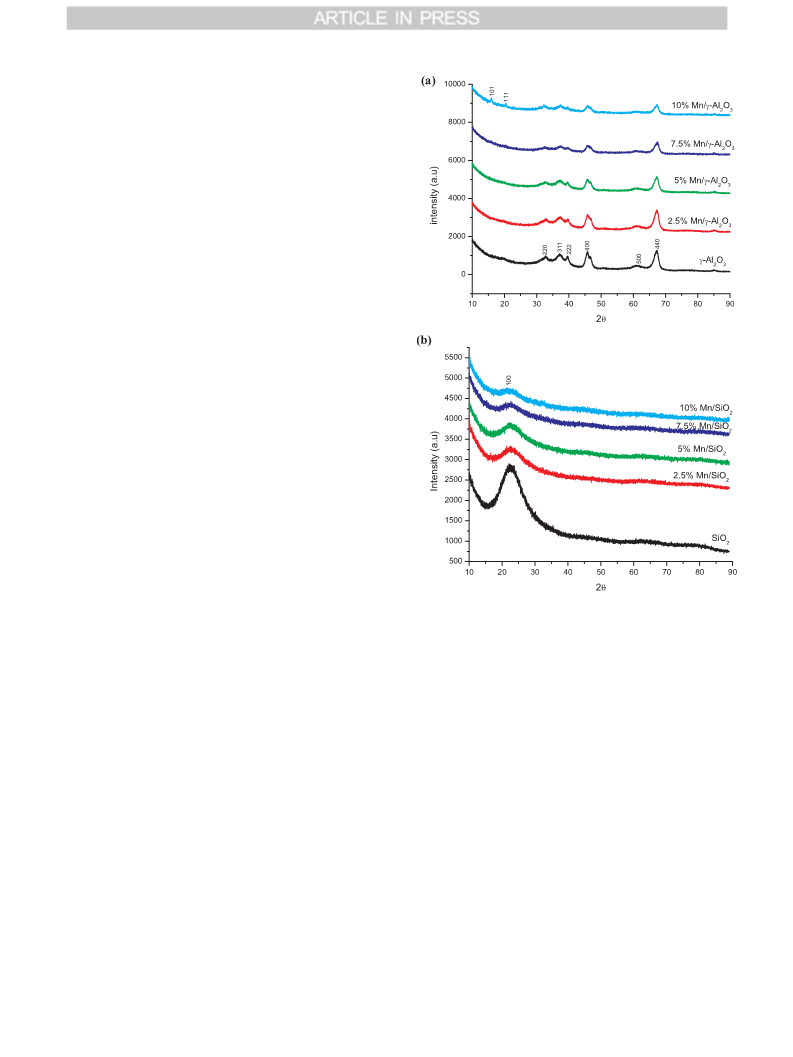
2.2.1. X-ray diffraction
X-ray diffraction is one the analysis that was performed to char-
acterise the catalysts. This technique was conducted to determine the
different phases of Mn (metal) and metal oxide (γ-Al2O3 and SiO2) that
is present in the catalyst and also crystal lattice of the support (γ-Al2O3
and SiO2). The powder diffraction patterns were recorded by using a
Bruker AXS-D8 with
a Cukα as radiation source of wavelength
0.15406 nm. Scan speed was 0.2/min over 10−90° scan range with
operating conditions of 40 kV and 40 mA.
2.2.2. Fourier transform-infrared spectroscopy (FT-IR)
In all calcined catalysts, the functional groups present were identi-
fied using FT-IR spectroscopy. The FT-IR spectroscopy analysis was
carried out using a Bruker Tensor 27 FT-IR spectrometer with a stan-
dard ATR cell. Acetone was used to clean the crystal’s surface prior to
every analysis. The force gauge adjusted to 22 gauge for proper contact
between the surfaces. The mid-IR region for catalyst was kept at the
The current study focuses on ozone-initiated oxidation of orthodi-
chlorobenzene catalyzed by manganese loaded on alumina and silica
supports at ambient reaction conditions.
range of 500−4000 cm−1
.
2.2.3. Scanning Electron Microscope (SEM)
2. Materials and methods
Scanning Electron Microscope was used to study the morphology
and topography of the both support and metal loaded calcined cata-
lysts. Carl Zeiss FE-SEM Sigma VP-03-67 instrument was used with
operating conditions of 20 kV over a working distance of 6−9 mm. All
the catalysts samples were dried and ground to fine powder with mortar
and pestle prior to the analysis. The analysis was then completed by
placing a small amount of the powdered sample on a piece of a two-way
carbon tape and then mounted on a stub (sample holder). The com-
positional analysis of the sample was then carried out on an Oxford
instrument X-MaxN 50 mode 54-XMX1003 EXD analyzer.
2.1. Materials
Aluminium oxide (γ-Al2O3, Aldrich, nanopowder < 50 nm particle
size, St. Louis, MO, Germany), 1,2-dichlorobenzene (Sigma Aldrich,
99.0 %), manganese(II) chloride tetrahydrate (MnCl2·4H2O, 99.0 %,
reagent grade, Aldrich St. Louis, MO, Germany) and silica gel (SiO2,
Merck, 70–230 mesh ASTM). These materials were purchased and used
without any further purification.
2.1.1. Catalyst preparation
2.2.4. Transmission Electron Microscopy (TEM)
Wet impregnation method was used to prepare metal (Mn) doped
metal oxide catalysts (Mn/γ-Al2O3 and Mn/SiO2). Adequate amount(s)
of manganese chloride tetrahydrate that was dissolved in 100 mL of
distilled water which was then calculated based on the percentage of
manganese (2.5, 5.0, 7.5 and 10.0 Wt%) that was supported on gamma
alumina and silica. For example, in this method to prepare 10 g of the
Transmission electron microscopy was used to study the mor-
phology, particle size and size distribution of all calcined catalysts. The
analysis was carried out on a JOEL JEM-2010 electron microscope with
an accelerating voltage of 200 kV. The images were captured with
Gatan camera and analyzed with Gatan imaging software. The samples
were prepared by dispensing fine powder of catalyst in toluene and
2

 Mkhize, Nomthandazo