Welcome to LookChem.com Sign In|Join Free
  • or

Encyclopedia

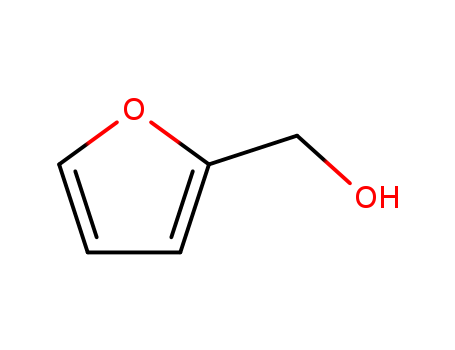
Furfuryl alcohol

Base Information
  • Chemical Name:Furfuryl alcohol
  • CAS No.:98-00-0
  • Deprecated CAS:1262335-14-7
  • Molecular Formula:C5H6O2
  • Molecular Weight:98.1014
  • Hs Code.:2932 13 00
  • European Community (EC) Number:202-626-1
  • ICSC Number:0794
  • NSC Number:8843
  • UN Number:2874
  • UNII:D582054MUH
  • DSSTox Substance ID:DTXSID2025347
  • Nikkaji Number:J3.578E
  • Wikipedia:Furfuryl_alcohol
  • Wikidata:Q27335
  • Metabolomics Workbench ID:46445
  • ChEMBL ID:CHEMBL308187
  • Mol file:98-00-0.mol
Furfuryl alcohol

Synonyms:2-furancarbinol;2-furylcarbinol;furfuryl alcohol

Suppliers and Price of Furfuryl alcohol
Supply Marketing:
Business phase:
The product has achieved commercial mass production*data from LookChem market partment
Manufacturers and distributors:
  • Manufacture/Brand
  • Chemicals and raw materials
  • Packaging
  • price
  • TRC
  • FurfurylAlcohol(1mg/Linacetonitrile)
  • 5 x 1ml
  • $ 55.00
  • TCI Chemical
  • Furfuryl Alcohol >98.0%(GC)
  • 25mL
  • $ 23.00
  • TCI Chemical
  • Furfuryl Alcohol >98.0%(GC)
  • 500mL
  • $ 64.00
  • SynQuest Laboratories
  • 2-(Hydroxymethyl)furan
  • 1 kg
  • $ 144.00
  • SynQuest Laboratories
  • 2-(Hydroxymethyl)furan
  • 250 g
  • $ 80.00
  • Sigma-Aldrich
  • Furfuryl Alcohol ≥97%, FG
  • 1 kg
  • $ 70.00
  • Sigma-Aldrich
  • Furfuryl Alcohol natural, ≥95%, FG
  • 1kg-k
  • $ 70.00
  • Sigma-Aldrich
  • Furfuryl Alcohol ≥97%, FG
  • 1kg-k
  • $ 70.00
  • Sigma-Aldrich
  • Furfuryl alcohol for synthesis. CAS 98-00-0, pH 6 (300 g/l, H O, 20 °C)., for synthesis
  • 8040151000
  • $ 67.30
  • Sigma-Aldrich
  • Furfuryl alcohol 98%
  • 1kg
  • $ 66.80
Total 36 raw suppliers
Chemical Property of Furfuryl alcohol
Chemical Property:
  • Appearance/Colour:clear yellow liquid 
  • Vapor Pressure:0.5 mm Hg ( 20 °C) 
  • Melting Point:-29 °C 
  • Refractive Index:n20/D 1.486(lit.)  
  • Boiling Point:169.999 °C at 760 mmHg 
  • PKA:14.02±0.10(Predicted) 
  • Flash Point:65 °C 
  • PSA:33.37000 
  • Density:1.14 g/cm3 
  • LogP:0.77190 
  • Storage Temp.:2-8°C 
  • Solubility.:alcohol: soluble 
  • Water Solubility.:MISCIBLE 
  • XLogP3:0.3
  • Hydrogen Bond Donor Count:1
  • Hydrogen Bond Acceptor Count:2
  • Rotatable Bond Count:1
  • Exact Mass:98.036779430
  • Heavy Atom Count:7
  • Complexity:54
  • Transport DOT Label:Poison
Purity/Quality:

98% *data from raw suppliers

FurfurylAlcohol(1mg/Linacetonitrile) *data from reagent suppliers

Safty Information:
  • Pictogram(s): HarmfulXn 
  • Hazard Codes:Xn,T 
  • Statements: 20/21/22-48/20-40-36/37-23-21/22 
  • Safety Statements: 23-36/37/39-63-45-36/37-24/25 
MSDS Files:

SDS file from LookChem

Total 1 MSDS from other Authors

Useful:
  • Chemical Classes:Other Classes -> Alcohols and Polyols, Other
  • Canonical SMILES:C1=COC(=C1)CO
  • Inhalation Risk:A harmful contamination of the air will be reached rather slowly on evaporation of this substance at 20 °C.
  • Effects of Short Term Exposure:The substance is irritating to the eyes and respiratory tract.
  • Effects of Long Term Exposure:The substance defats the skin, which may cause dryness or cracking. Repeated or prolonged contact with skin may cause dermatitis. The substance may have effects on the upper respiratory tract and kidneys. This substance is possibly carcinogenic to humans.
  • Description Furfuryl alcohol is clear colorless organic liquid having a furan substituted with a hydroxymethyl group. It is primarily used for the synthesis of furans resins which are used in thermoset polymer matrix composites, cements, adhesive and coatings. It plays an essential role in the production of foundry sand binder and has long been used to produce cores and molds for metal casting. Other applications include as a fuel and wood treatment. In industry, it is manufactured through either direct reduction of furfural, or through the disproportionation via the Cannizaro reaction in NaOH solution. The basic raw materials for its manufacturing are waste vegetable materials such as rice hulls, sugar cane bagasse, oat hulls or corncobs.
  • Physical properties Clear, colorless to pale yellow liquid with an irritating odor. Darkens to yellowish-brown on exposure to air. A detection odor threshold concentration of 32 mg/m3 (8.0 ppmv) was determined by Jacobson et al. (1958).
  • Uses Colorless liquid that turns dark in air Furfuryl Alcohol has been obtained by yeast reduction of furfural. Furfuryl Alcohol is used as solvent and in the manufacturing of wetting agents, resins. Solvent; manufacture of wetting agents, resins.
Technology Process of Furfuryl alcohol

There total 362 articles about Furfuryl alcohol which guide to synthetic route it. The literature collected by LookChem mainly comes from the sharing of users and the free literature resources found by Internet computing technology. We keep the original model of the professional version of literature to make it easier and faster for users to retrieve and use. At the same time, we analyze and calculate the most feasible synthesis route with the highest yield for your reference as below:

synthetic route:
Guidance literature:
With isopropyl alcohol; In decane; at 160 ℃; for 8h; under 15001.5 Torr; Autoclave; Inert atmosphere;
Guidance literature:
With magnesium oxide; at 100 - 160 ℃; for 3h; under 45004.5 Torr; Temperature; Time; Pressure; Inert atmosphere; Autoclave;
Refernces

Total synthesis of (+)-Z-deoxypukalide, a furanobutenolide-based cembranoid isolated from the pacific octocoral Leptogorgia spp.

10.1016/j.tet.2010.01.059

The research aims to achieve a total synthesis of (t)-Z-deoxypukalide, a furanobutenolide-based cembranoid, using a combination of Stille and Nozaki–Hiyama–Kishi (NHK) coupling reactions as key steps. The study also developed a practical synthesis of the substituted butenolide intermediate 10 using a combination of ring-closing metathesis (RCM) and cross-metathesis (CM) reactions. The synthesis involved creating enantiomerically pure alkenyl iodides 10 and 11, which were then coupled with a stannylfuran intermediate to form alkenylfurans 28 and 29. However, intramolecular NHK reactions on these alkenylfurans resulted in low yields of the desired macrocyclic products. The researchers then successfully synthesized (t)-Z-deoxypukalide via a different route, starting from a furanmethanol derivative and using NHK conditions to form the macrocyclic homoallylic alcohol 37, which was then converted to the final product. The synthetic (t)-Z-deoxypukalide was confirmed to match the natural product in terms of spectroscopic data. The study concludes that while the intramolecular NHK reaction has limitations when an ester group is adjacent to the reacting aldehyde, alternative synthetic routes can achieve the desired natural product. Key chemicals used in the research include the starting materials such as cyclobutene ester 21, stannylfuran 27, and various reagents like Grubbs' catalyst, CrCl2, and tetrabutylammonium fluoride.

Promotion effect of Ce or Zn oxides for improving furfuryl alcohol yield in the furfural hydrogenation using inexpensive Cu-based catalysts

10.1016/j.mcat.2018.06.001

This study investigated the use of cerium or zinc oxides as promoters to improve the yield of furfuryl alcohol in the hydrogenation of furfural using an inexpensive copper-based catalyst supported on a mixed layer of cerolite/magnesium-montmorillonite. It was found that high copper loadings (15-30 wt.% copper) maintained high furfural conversions above 80 mol% after 5 h at 210 °C, while the addition of cerium oxide (CeO) or zinc oxide (ZnO) as promoters, while reducing furfural conversion, significantly improved the selectivity of furfuryl alcohol, reaching a maximum yield of above 80% after 5 h at 190 °C. The effects of copper content and the presence of promoters on the catalytic performance were also investigated, with the results indicating that moderate copper loadings favored the formation of 2-methylfuran, while higher loadings and the addition of cerium oxide (CeO) or zinc oxide (ZnO) improved the selectivity of furfuryl alcohol. The study concluded that the addition of CeO2 or ZnO changes the electron density of the active phase, thereby improving the selectivity of furfuryl alcohol and reducing the deactivation due to carbonaceous deposition.

Furfuryl alcohol in synthesis of levulinic acid esters and difurylmethane with Fe and Rh complexes

10.1134/S1070427207100163

R. I. Khusnutdinov et al. explore the synthesis of levulinic acid esters and difurylmethane using furfuryl alcohol. The study investigates the reaction of furfuryl alcohol with aliphatic alcohols in a CCl4 system catalyzed by Fe(acac)3, achieving high yields of 80-98% for levulinic acid esters. The presence of HCl in the reaction mixture, formed from alcohols and CCl4 under the influence of iron compounds, is suggested to play a role in the catalysis. The authors also demonstrate the synthesis of 2,2'-difurylmethane in an 80% yield using Rh(PPh3)3Cl as a catalyst in a reaction with water and CCl4. The study provides a simpler and more accessible method for synthesizing these compounds compared to existing procedures, supported by spectral data confirming the structures of the synthesized compounds.


Post a RFQ

Enter 15 to 2000 letters.Word count: 0 letters

Attach files(File Format: Jpeg, Jpg, Gif, Png, PDF, PPT, Zip, Rar,Word or Excel Maximum File Size: 3MB)

1 Customer Service

What can I do for you?
Get Best Price

Get Best Price for 98-00-0