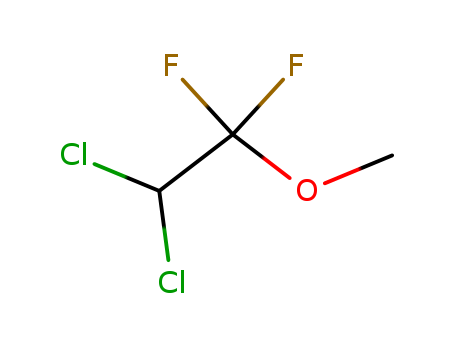
Chemical Property of Methoxyflurane
Chemical Property:
- Appearance/Colour:colourless liquid
- Vapor Pressure:19300mmHg at 25°C
- Melting Point:-36°C
- Refractive Index:1.386
- Boiling Point:103 °C
- Flash Point:63 C
- PSA:9.23000
- Density:1.4262
- LogP:2.02930
- Storage Temp.:-70°C
- Water Solubility.:Miscible with alcohol, acetone, chloroform, ether, fixed oils and benzene. Immiscible with water.
- XLogP3:2.2
- Hydrogen Bond Donor Count:0
- Hydrogen Bond Acceptor Count:3
- Rotatable Bond Count:2
- Exact Mass:163.9607265
- Heavy Atom Count:8
- Complexity:75.7
- Transport DOT Label:Combustible Liquid
- Purity/Quality:
-
98% *data from raw suppliers
MYST3 *data from reagent suppliers
Safty Information:
- Pictogram(s):
R10:Flammable.;
- Hazard Codes:Xi
- Statements:
10
- Safety Statements:
23-24/25
- MSDS Files:
-
SDS file from LookChem
Total 1 MSDS from other Authors
Useful:
- Chemical Classes:Other Uses -> Waste Anesthetic Gases
- Canonical SMILES:COC(C(Cl)Cl)(F)F
- Recent ClinicalTrials:METHOXYFLURANE or Virtual Reality Headset vs Standard Analgesic Management for the Reduction of Anterior Shoulder Dislocation (HYPNOLUX)
- Recent EU Clinical Trials:Pain relief of methoxyflurane in patients with burns
- Inhalation Risk:No indication can be given about the rate at which a harmful concentration of this substance in the air is reached on evaporation at 20 °C.
- Effects of Short Term Exposure:Exposure at high levels could cause unconsciousness.
- Effects of Long Term Exposure:The substance may have effects on the kidneys. This may result in kidney impairment.
-
Uses
Methoxyflurane is used as a clinical anesthesia (inhalation). Methoxyflurane is a very potent and highly lipid soluble anesthetic agent. Methoxyflurane causes deep sedation and it has been used as a patient controlled analgesic for painful procedures in children. Methoxyflurane is a significant respiratory depressant. 2,2-Dichloro-1,1-difluoroethyl methyl ether is used as a lipid soluble anesthetic agent. It is a neuromuscular blocking agent given concurrently to get the desired degree of muscular relaxation. Further, it is a powerful analgesic agent.
-
Biological Functions
Methoxyflurane (Penthrane) is the most potent inhalational
agent available, but its high solubility in tissues limits
its use as an induction anesthetic. Its pharmacological
properties are similar to those of halothane with some
notable exceptions. For example, since methoxyflurane
does not depress cardiovascular reflexes, its direct myocardial
depressant effect is partially offset by reflex
tachycardia, so arterial blood pressure is better maintained.
Also, the oxidative metabolism of methoxyflurane
results in the production of oxalic acid and fluoride concentrations
that approach the threshold of causing renal
tubular dysfunction. Concern for nephrotoxicity has
greatly restricted the use of methoxyflurane.
-
Clinical Use
Methoxyflurane is seldom used because of its propensity to cause renal toxicity. It is
the most potent agent, and it has the highest solubility in blood. Induction
and recovery would be expected to be slow. Chemically, it is rather unstable, and as much as 50%
of an administered dose can be metabolized. Toxic metabolites significantly limit its utility as a
general anesthetic.