Welcome to LookChem.com Sign In|Join Free
  • or

Encyclopedia

Mercurius cyanatus [hpus]

Base Information
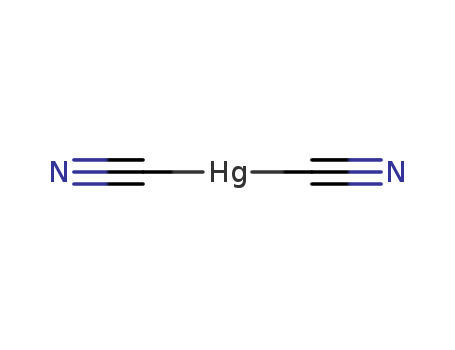
  • Chemical Name:Mercurius cyanatus [hpus]
  • CAS No.:592-04-1
  • Molecular Formula:C2Hg N2
  • Molecular Weight:295.688
  • Hs Code.:2837199090
  • UNII:RWG7BD1032
  • Mol file:592-04-1.mol
Mercurius cyanatus [hpus]

Synonyms:MERCURIC CYANIDE [MI];SCHEMBL314258;MERCURIC CYANIDE [HSDB];MERCURIUS CYANATUS [HPUS];MERCURIC CYANIDE [WHO-DD]

Suppliers and Price of Mercurius cyanatus [hpus]
Supply Marketing:
Business phase:
The product has achieved commercial mass production*data from LookChem market partment
Manufacturers and distributors:
  • Manufacture/Brand
  • Chemicals and raw materials
  • Packaging
  • price
  • Strem Chemicals
  • Mercury(II) cyanide, 99%
  • 50g
  • $ 247.00
  • Strem Chemicals
  • Mercury(II) cyanide, 99%
  • 250g
  • $ 989.00
  • TRC
  • Mercury(II)Cyanide
  • 10g
  • $ 245.00
Total 1 raw suppliers
Chemical Property of Mercurius cyanatus [hpus]
Chemical Property:
  • Vapor Pressure:740mmHg at 25°C 
  • Melting Point:46.85°C 
  • Boiling Point:°Cat760mmHg 
  • Flash Point:°C 
  • PSA:47.58000 
  • Density:g/cm3 
  • LogP:0.03106 
  • Storage Temp.:Poison room 
  • Water Solubility.:g/100g solution H2O: 6.31 (0°C), 10.06±0.06 (25°C), 35.05 (101.1°C) [KRU93]; 1g dissolves in 13mL alcohol, 4mL methanol; slightly soluble ether; slowly soluble glycerol [MER06] 
  • Hydrogen Bond Donor Count:0
  • Hydrogen Bond Acceptor Count:4
  • Rotatable Bond Count:0
  • Exact Mass:253.976792
  • Heavy Atom Count:5
  • Complexity:10
Purity/Quality:

98% min. *data from raw suppliers

Mercury(II) cyanide, 99% *data from reagent suppliers

Safty Information:
  • Pictogram(s): Toxic by ingestion, inhalation, and skin absorption. TLV: TWA 0.1 mg(Hg)/m3
  • Hazard Codes:T+,N 
  • Statements: 26/27/28-32-50/53 
  • Safety Statements: 7-28-29-45-60-61 
MSDS Files:

SDS file from LookChem

Total 1 MSDS from other Authors

Useful:
  • Canonical SMILES:[C-]#N.[C-]#N.[Hg+2]
  • Uses Mercuric cyanide finds veterinary application as a topical antiseptic for cats and other animals. Medicine (antiseptic), germicidal soaps, manufacturing cyanogen gas, photography.
Technology Process of Mercurius cyanatus [hpus]

There total 44 articles about Mercurius cyanatus [hpus] which guide to synthetic route it. The literature collected by LookChem mainly comes from the sharing of users and the free literature resources found by Internet computing technology. We keep the original model of the professional version of literature to make it easier and faster for users to retrieve and use. At the same time, we analyze and calculate the most feasible synthesis route with the highest yield for your reference as below:

synthetic route:
Guidance literature:
With water; mercury(II) oxide;
Refernces

SYNTHESIS OF A GLYCOTRIPEPTIDE AND A GLYCOSOMATOSTATIN CONTAINING THE 3-O-(2-ACETAMIDO-2-DEOXY-β-D-GLUCOPYRANOSYL)-L-SERINE RESIDUE

10.1016/S0008-6215(00)85248-9

A study detailing the synthesis of a glycotripeptide and a glycosomatostatin, both containing the 3-O-(2-acetamido-2-deoxy-D-glucopyranosyl)-L-serine residue. The research was conducted by a team from the Salk Institute for Biological Studies and the University of California, San Diego. The process involved solid-phase synthesis to create the sequences Gly-[P-D-GlcpNAc-(1→3)-Ser]-Ala-OH and /I-D-GlcpNAc-(1→3)-Ser-13-somatostatin. The synthesized glycopeptides were found to be homogeneous upon examination through thin-layer chromatography (t.l.c.) and liquid chromatography (l.c.), and they exhibited the correct amino acid composition and 2-amino-2-deoxy-D-glucose content. The structure of one of the glycopeptides was confirmed by mass spectrometry and nuclear magnetic resonance (n.m.r.) spectroscopy. The study was supported by grants from the National Institute of Arthritis, Metabolism, and Digestive Diseases, the National Heart Institute, and the William Randolph Hearst Foundation, among others.

A facile synthesis of benzyl 2-acetamido-6-O-acetyl-4-O-(6-O-acetyl-3,4-O-isopropylidene-β-D-galactopyranosyl)-2-deoxy-β-D-glucopyranoside, a key intermediate for the synthesis of O-α-L-fucopyranosyl-(1->2)-O-β-D-galactopyranosyl-(1->4)-O-<α-L-fucopyranos

10.1016/0008-6215(83)88254-8

This research aims to develop a convenient and practical method for synthesizing complex saccharides that are part of glycoconjugates. The study focuses on synthesizing a key intermediate compound for the production of a specific carbohydrate structure found in blood-group substances. The researchers used various chemicals, including benzyl alcohol, mercuric cyanide, hexamethyl-disilazane, chlorotrimethylsilane, acetic anhydride, and 2,2-dimethoxypropane, among others, to achieve the desired synthesis. The process involved multiple steps of acetylation, deacetylation, silylation, and isopropylidenation. The final product was obtained in good yields and its structure was confirmed through NMR spectroscopy. The study concludes that the synthesized intermediate could be a suitable precursor for the further synthesis of more complex oligosaccharides, potentially useful in the study of glycosidases, glycosyltransferases, and as synthetic antigens.

Post a RFQ

Enter 15 to 2000 letters.Word count: 0 letters

Attach files(File Format: Jpeg, Jpg, Gif, Png, PDF, PPT, Zip, Rar,Word or Excel Maximum File Size: 3MB)

1 Customer Service

What can I do for you?
Get Best Price

Get Best Price for 592-04-1
