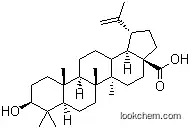



472-15-1Relevant academic research and scientific papers
A SAPONIN FROM ASPARAGUS GONOCLADUS
Mandloi, Dilip,Sant, P. G.
, p. 1687 - 1688 (1981)
The ethanolic extract of the aerial part of Asparagus gonocladus yielded a new saponin.It was identified as lup-20(29)-en-28-oic-3-O-α-L-rhamnopyranosyl-(2->1)-O-β-D-glucopyranoside. - Keywords: Asparagus gonocladus; Liliaceae; lup-20(29)-en-28-oic-3-O-α-L-rhamnopyranosyl-(2->1)-O-β-D-glucopyranoside.
Toward a benign strategy for the manufacturing of betulinic acid
Ressmann, Anna K.,Kremsmayr, Thomas,Gaertner, Peter,Zirbs, Ronald,Bica, Katharina
, p. 1014 - 1022 (2017)
We report a novel and efficient strategy for the preparation of the high-value triterpenoid betulinic acid based on extraction and streamlined oxidation of betulin from the industrial by-product birch bark. The initial extraction of betulin relies on a biphasic system and allowed extracting betulin in short times at room temperature. The crude extract could be directly oxidized, thereby providing a chromium-free, time- and energy saving strategy for the manufacturing of betulinic acid in high yield.
α-L-RHAMNOPYRANOSYL-3β-HYDROXY-LUP-20(29)-EN-28-OIC ACID FROM THE STEM OF DILLENIA PENTAGYNA
Tiwari, Kamala P.,Srivastava, Savitri D.,Srivastava, Santosh K.
, p. 980 - 981 (1980)
Key Word Index: Dillenia pentagyna; Dilleniaceae; α-L-rhamnopyranosyl-3β-hydroxy-lup-20(29)-en-28-oic acid; a new saponin.
Sulfonation of Betulinic Acid by Sulfamic Acid
Levdanskii,Levdanskii,Kuznetsov
, p. 894 - 896 (2015)
Betulinic acid was sulfonated by sulfamic acid in the presence of urea in homogeneous 1,4-dioxane or DMF solution at 65-75°C in 2.5-3.5 h to give betulinic acid 3-sulfate, the structure of which was confirmed by IR and 13C NMR spectroscopy.
Design, synthesis and evaluation of antiproliferative activity of fluorinated betulinic acid
Li, Jizhen,Chang, Ling-Chu,Hsieh, Kan-Yen,Hsu, Pei-Ling,Capuzzi, Stephen J.,Zhang, Ying-Chao,Li, Kang-Po,Morris-Natschke, Susan L.,Goto, Masuo,Lee, Kuo-Hsiung
, p. 2871 - 2882 (2019)
Betulinic acid (BA), a pentacyclic triterpenoid, exhibits broad spectrum antiproliferative activity, but generally with only modest potency. To improve BA's pharmacological properties, fluorine was introduced as a single atom at C-2, creating two diastereomers, or in a trifluoromethyl group at C-3. We evaluated the impact of these groups on antiproliferative activity against five human tumor cell lines. A racemic 2-F-BA (compound 6) showed significantly improved antiproliferative activity, while each diastereomer exhibited similar effects. We also demonstrated that 2-F-BA is a topoisomerase (Topo) I and IIα dual inhibitor in cell-based and cell-free assays. A hypothetical mode of binding to the Topo I-DNA suggested a difference between the hydrogen bonding of BA and 2-F-BA to DNA, which may account for the difference in bioactivity against Topo I.
Glucosidation of betulinic acid by Cunninghamella species
Chatterjee, Parnali,Pezzuto, John M.,Kouzi, Samir A.
, p. 761 - 763 (1999)
Microbial transformation of the antimelanoma agent betulinic acid (1) was studied. Preparative scale biotransformation with resting-cell suspensions of Cunninghamella species NRRL 5695 resulted in the production of a fungal metabolite of 1, which has been characterized as 28-O-β-D- glucopyranosyl 3β-hydroxy-lup-20(29)-en-28-oate (2) based on spectral and enzymic data. The in vitro cytotoxicity assay of metabolite 2 revealed no activity against several human melanoma cell lines.
A BETULINIC ACID GLYCOSIDE FROM SCHEFFLERA VENULOSA
Purohit, M. C.,Pant, G.,Rawat, M. S. M.
, p. 2419 (1991)
A new betulinic acid glycoside, lup-20(29)-en-28-oic-3-O-β-D-glucopyranosyl (2->1)-O-β-D-glucopyranoside has been characterized from the leaves of Schefflera venulosa.
Triterpenoid saponins from the buds of Lonicera similis
Zhang, Xiao,Zou, Li-Hua,He, Yu-Lin,Peng, Cheng,Guo, Li,Xiong, Liang
, p. 2282 - 2290 (2018)
Four new lupane triterpenoid saponins, along with one known lupane and eight hederagenin saponins, were isolated from the EtOH extract of the buds of Lonicera similis Hemsl. The structures of the new compounds were established as 3-O-β-D-glucopyranosyl-(1→2)-β-D-glucopyranosyl 23-hydroxybetulinic acid 28-O-β-D-glucopyranosyl ester (lonisimilioside A, 1), 3-O-β-D-glucopyranosyl-(1→2)-β-D-glucopyranosyl 23-hydroxybetulinic acid 28-O-β-D-glucopyranosyl-(1→6)-β-D-glucopyranosyl ester (lonisimilioside B, 2), 3-O-β-D-glucopyranosyl-(1→2)-β-D-glucopyranosyl betulinic acid 28-O-β-D-glucopyranosyl-(1→6)-β-D-glucopyranosyl ester (lonisimilioside C, 3) and 3-O-β-D-glucopyranosyl-(1→2)-β-D-glucopyranosyl-(1→6)-β-D-glucopyranosyl betulinic acid 28-O-β-D-glucopyranosyl ester (lonisimilioside D, 4), respectively. The cytotoxic activities of the isolates against human cancer cell lines HepG2, MCF-7 and A-549 were evaluated. Only the monodesmosidic saponin with a free carboxyl group at C-28 (12) exhibited significant cytotoxicities against HepG2, MCF-7 and A-549 cell lines with the IC50 values of 8.98?±?0.19, 12.48?±?0.45 and 11.62?±?0.54?μM, respectively. Furthermore, Hoechst fluorescence 33342 staining was used to demonstrate that 12 could induce HepG2 and A-549 cells apoptosis significantly.
Genotoxic and mutagenic properties of synthetic betulinic acid and betulonic acid
Frolova,Kukina,Sinitsyna
, p. 409 - 413 (2015)
Abstract Betulinic acid was synthesized from birch bark extract (Betula pendula), with betulonic acid being an intermediate of the synthesis. Both compounds were isolated with a purity of 95%. Genotoxicity and mutagenicity of the prepared compounds was analyzed by the Ames test and SOS chromotest and it was found that the substances show no mutagenic and genotoxic activity.
The Effect of Experimental BCG Antigen–Betulin-Derived Conjugates on the Guinea Pig Immunological Response
Koshkin, I. N.,Kulakov, I. V.,Vlasenko, V. S.
, p. 837 - 844 (2021/08/25)
Abstract: The immunopotentiating properties of BCG vaccine strain antigen conjugated with betulin derivatives have been evaluated. The experiments were carried out on agouti guinea pigs (n = 20). The animals of the experimental groups (n = 5) were immunized with the following antituberculosis drugs: group 1, with antigens of the BCG vaccine strain conjugated with betulinic acid; group 2, with BCG antigens conjugated with betulonic acid; and group 3, with the BCG vaccine. The animals of the control group (n = 5) were injected with a saline solution. All the animals were infected with a virulent culture of Mycobacterium bovis (strain 8) on day 30 after the administration of antituberculosis drugs. The blood sampling for the assessment of the immune status was conducted on day 30 after the administration of drugs and day 30 after the infection with M. bovis. The designed conjugates were found to display immunopotentiating activity characterized by a 1.7–3.8-fold increase in the number of immunocompetent cells and an increase in the neutrophil functional activity observed to a greater degree in the guinea pig group 2. After infection with M. bovis some key parameters of the immune system, such as a T-lymphocyte count and the activity of enzymatic (myeloperoxidase) and nonenzymatic (cationic proteins) bactericidal systems of neutrophilic granulocytes significantly increased in groups 2 and 3, which implied the highest antituberculosis activity of the agents administered to these animals. The guinea pigs were euthanized 45 days after the infection with M. bovis. The next pathoanatomical experiments proved that the vaccine strain conjugates with betulonic acid and the BCG vaccine induced marked resistance against the pathogenic mycobacteria. The protection indexes for these agents were approximately the same and achieved 66 and 71%, respectively.


