7
8
H. Ross, J. Bendig and S. Hecht, Sol. Energy Mater. Sol. Cells,
oxidation of positive holes or the attack of hydroxyl radicals.
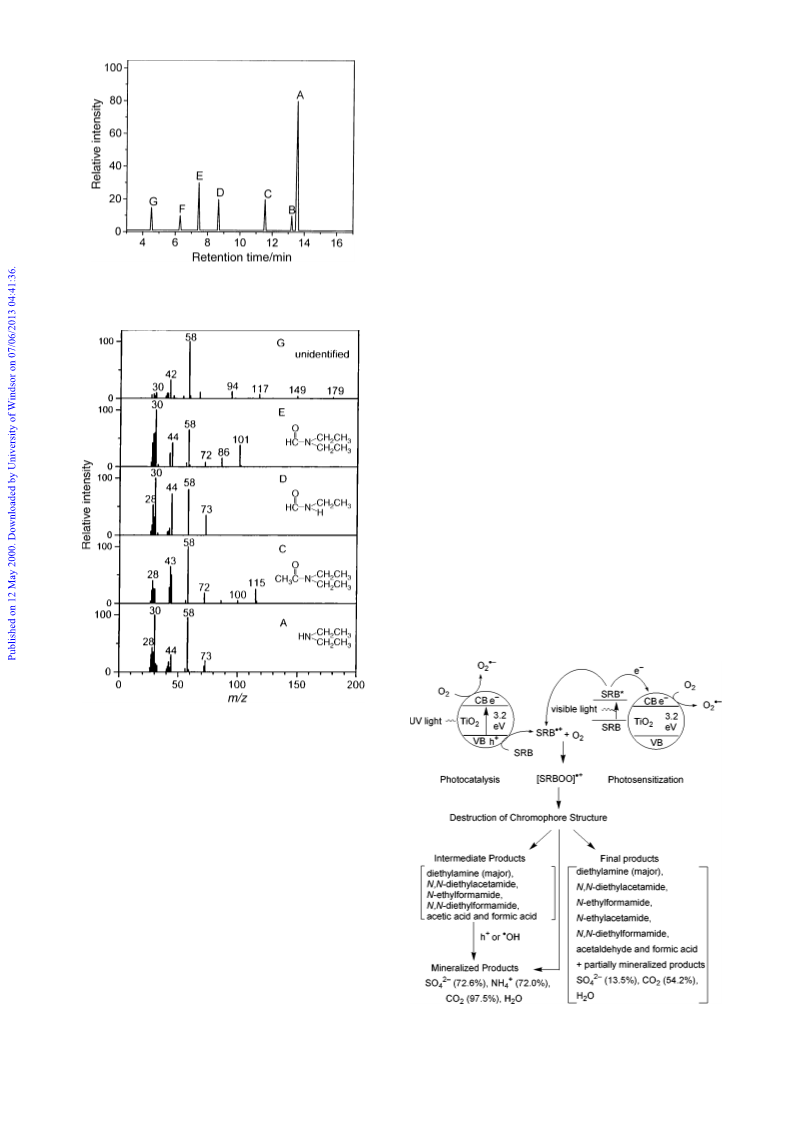
On the contrary, in the photosensitization, the transformation
of dye cation radicals produces the Ðnal degraded products
1
994, 33, 475.
(a) F. Zhang, J. Zhao, L. Zang, T. Shen, H. Hidaka, E. Pelizzetti
and N. Serpone, J. Mol. Catal. A: Chem., 1997, 120, 173; (b) F.
Zhang, J. Zhao, T. Shen, H. Hidaka, E. Pelizzetti and N. Serpone,
Applied Catal. B: Environ., 1998, 15, 147; (c) J. Zhao, K. Wu, T.
Wu, H. Hidaka and N. Serpone, J. Chem. Soc. Faraday T rans.,
(e.g. diethylamine, N-ethylacetamide, N-ethylformamide, N,N-
diethylacetamide, N,N-diethylformamide, HCOOH and
CH CHO), which would not be further mineralized under
3
1
998, 94, 673.
visible light irradiation, the mechanism of their degradation is
9
0
(a) T. Wu, G. Liu, J. Zhao, H. Hidaka and N. Serpone, J. Phys.
Chem. B, 1998, 102, 5845; (b) J. Zhao, T. Wu, K. Wu, K. Oikawa,
H. Hidaka and N. Serpone, Environ. Sci. T echnol., 1998, 32, 2394.
(a) T. Wu, T. Lin, J. Zhao, H. Hidaka and N. Serpone, Environ.
Sci. T echnol., 1999, 33, 1379; (b) G. Liu, T. Wu, J. Zhao, H.
Hidaka and N. Serpone, Environ. Sci. T echnol., 1999, 33, 2081.
Chinese National Standard: GB 11914È89, 1989.
probably related to the active oxygen radicals produced in the
photosensitization process, while independent of the medi-
ation of the positive holes as occurs in the direct photo-
catalysis.
1
1
1
1
2
T. Watanabe, T. Takizawa and K. Honda, J. Phys. Chem., 1977,
Conclusions
81, 1845.
The dye SRB can be e†ectively degraded by both the direct
and sensitized photocatalysis. Similar intermediates (such as
diethylamine, N,N-diethylacetamide, N-ethylformamide, N,N-
13 G. Liu, X. Li, J. Zhao, H. Hidaka and N. Serpone, Environ. Sci.
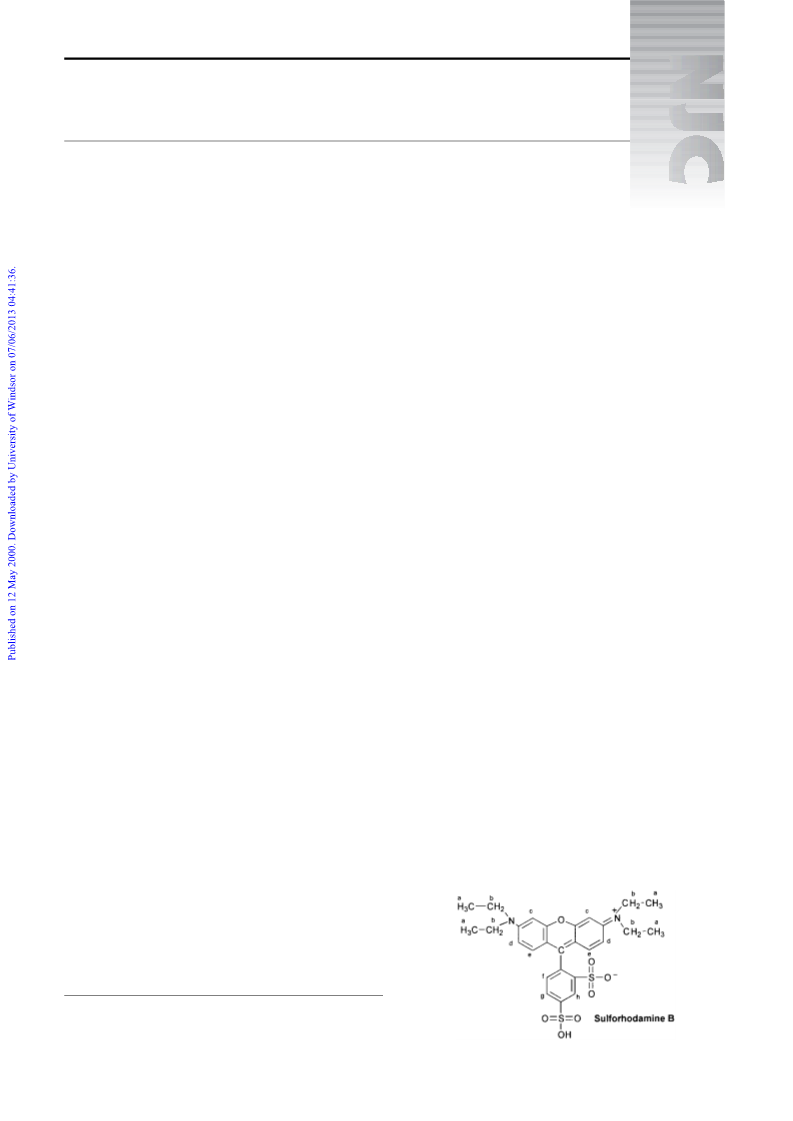
T echnol., submitted. ““In this paper, the photooxidation of sul-
forhodamine B has been examined under visible light illumi-
nation, two di†erent oxidation pathways are described to
account for di†erences in the Ðnal photooxidation products
whose nature depends on the di†erent modes of adsorption of the
diethylformamide, formic acid) and Ðnal products (SO 2~,
4
CO ) were identiÐed by UV-Vis spectra, TOC, COD, IR,
1
2
HNMR and GC-MS techniques in the two di†erent degrada-
dye sulforhodamine B on the metal-oxide mediator (TiO ).ÏÏ
2
tion processes, but their distribution is dependent on the
photocatalytic mechanism. Direct and sensitized photo-
catalyses appear to involve similar photodegradation path-
ways in the initial stages, leading to a rapid destruction of
SRB chromophore structure to form smaller organic species
except that direct photocatalysis is capable of achieving com-
plete mineralization with further irradiation. Ammonium is
the exclusive primary inorganic nitrogen species produced in
the direct photocatalysis, which is not found in the sensitiza-
tion. The application of direct and sensitized photocatalysis
has the potential for the treatment of dye pollutants because it
can fully utilize solar radiation.
14 E. E. Wegner and A. W. Adamson, J. Am. Chem. Soc., 1966, 88,
3
94.
1
5
6
U. Sta†ord, K. A. Gray and P. V. Kamat, J. Phys. Chem., 1994,
9
8, 6343.
1
J. Zhao, H. Hidaka, A. Takamura, E. Pelizzetti and N. Serpone,
L angmuir, 1993, 9, 1646.
17 K. Nohara, H. Hidaka, E. Pelizzetti and N. Serpone, Catal. L ett.,
1996, 36, 115.
18
19
20
21
K. Nohara, H. Hidaka, E. Pelizzetti and N. Serpone, J. Photo-
chem. Photobiol. A, 1997, 102, 265.
H. Hidaka, K. Nohara, J. Zhao, K. Takashima, E. Pelizzetti and
N. Serpone, New J. Chem., 1994, 18, 541.
M. J. S. Dewar, E. G. Zoebisch, E. F. Healy and J. J. P. Stewart,
J. Am. Chem. Soc., 1985, 107, 3902.
H. Bader, V. Sturzenegger and J. Hoigne, W ater Res., 1988, 22,
1
109.
2
2
2
3
Y. Zuo and J. Hoigne, Science, 1993, 260, 71.
E. R. Carraway, A. J. Ho†mann and R. Ho†mann, Environ. Sci.
T echnol., 1994, 28, 786.
Acknowledgements
The generous Ðnancial support of this work from the National
Natural Science Foundation of China (No. 29725715, No.
2
4
5
T. Wu, G. Liu, J. Zhao, H. Hidaka and N. Serpone, J. Phys.
Chem. B, 1999, 103, 4862.
59772033 and No. 29637010), the Foundation of the Chinese
2
K. Sehested, O. L. Rasmussen and H. Fricke, J. Phys. Chem.,
Academy of Sciences and the China National Committee for
Science and Technology is gratefully acknowledged.
1
968, 72, 626.
26 B. H. J. Bielski, D. E. Cabelli, R. L. Arudi and A. B. Ross, J.
Phys. Chem. Ref. Data, 1985, 14, 1041.
2
7 D. T. Sawyer and J. S. Valentine, Acc. Chem. Res., 1981, 14, 393.
References
28 P. N. O. Mchedlov, S. A. Shapovalov, S. I. Egorova, V. N. Klesh-
chevnikova and E. A. Cordova, Dyes Pigm., 1995, 28, 7.
29 M. R. Ho†mann, S. T. Martin, W. Choi and D. W. Bahnemann,
Chem. Rev., 1995, 95, 69.
30 W. Choi and M. R. Ho†mann, J. Phys. Chem., 1996, 100, 2161.
31 (a) P. V. Kamat, Chem. Rev., 1993, 93, 267; (b) M. A. Fox and
M. T. Dulay, Chem. Rev., 1993, 93, 341.
32 M. A. Fox, R. B. Draper, K. E. OÏShea, in Photochemical Conver-
sion and Storage of Solar Energy, eds. E. Pelizzetti, and M. Schia-
vello, Kluwer, Dordrecht, 1991, p. 323.
33 A. Wahl, M. Ulmann, A. Carroy, B. Jermann, M. Dolata, P. Ked-
zierzawski, C. Chatelain, A. Monnier and J. Augustynski, J. Elec-
troanal. Chem., 1995, 396, 41.
1
2
D. Brown and P. Laboureur, Chemosphere, 1983, 12, 397.
J. McCann and B. N. Ames, Proc. Natl. Acad. Sci. USA, 1975, 73,
9
50.
3
4
W. C. Tincher, T ext. Chem. Color., 1989, 21, 33.
D. F. Ollis, E. Pelizzetti and N. Serpone, Environ. Sci. T echnol.,
1
991, 25, 1522.
5
6
R. W. Matthews, J. Catal., 1988, 111, 264.
(a) K. Vinodgopal, D. Wynkoop and P. V. Kamat, Environ. Sci.
T echnol., 1996, 30, 1660; (b) C. Nasr, K. Vinodgopal, L. Fisher, S.
Hotchandani, A. K. Chattopadhya and P. V. Kamat, J. Phys.
Chem., 1996, 100, 8436.
New J. Chem., 2000, 24, 411È417
417

 Liu, Guangming