Communications
ment that the reaction rate between Zn(CH3COO)2 and
The route reported here is applicable to preparation of
other mesoporous spinel AB2O4-type oxides. Mesoporous
CoGa2O4 and NiGa2O4 were synthesized by this method.
Unlike ZnGa2O4, the MGa2O4 (M = Co, Ni) samples obtained
by ion exchange at room temperature are amorphous. The
specific surface areas of amorphous NiGa2O4 and CoGa2O4
are 363.3 and 202.3 m2 gꢀ1, respectively. The samples exhibited
a uniform pore size distribution. TEM observations (see
Supporting Information) showed that the wormholes in these
amorphous products are similar to those in the NaGaO2
colloid due to the amorphous phase transformation with
slight particle growth. By hydrothermal treatment of these
amorphous samples at 1808C for 5 h, crystalline mesoporous
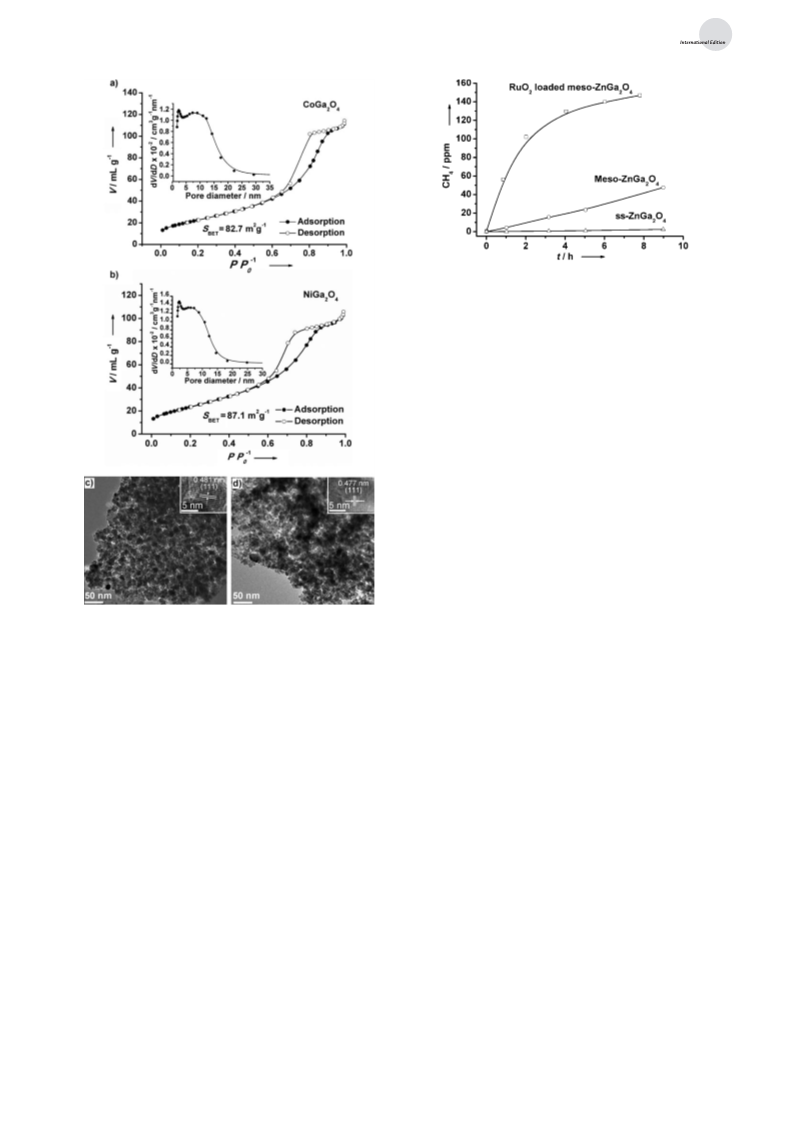
CoGa2O4 and NiGa2O4 can be obtained. Compared with the
amorphous products, the specific surface areas of crystalline
CoGa2O4 and NiGa2O4 decreased to 82.7 and 87.1 m2 gꢀ1,
respectively. The pore sizes of crystalline mesoporous
CoGa2O4 and NiGa2O4 exhibit bimodal distributions
(Figure 4), and the average values of the pore diameter
were 2.5 and 8 nm, respectively. The grain size of crystalline
CoGa2O4 and NiGa2O4 is about 10 nm (see Supporting
Information). Therefore, the results of these experiments
indicate that amorphous MGa2O4 (M = Co, Ni) can form
rapidly at room temperature, and that subsequent hydro-
thermal treatment induces crystallization and growth of the
amorphous particles. The mesopores in CoGa2O4 and
NiGa2O4 are formed by agglomeration of nanoparticles,
similar to meso-ZnGa2O4. Compared with amorphous
CoGa2O4 and NiGa2O4, the bimodal pore size distribution
and low BET surface area of crystalline CoGa2O4 and
NiGa2O4 can be attributed to grain growth during hydro-
thermal treatment.
NaGaO2 is appropriate for nucleating and growing crystalline
ZnGa2O4. The TEM images show that meso-ZnGa2O4 also
has a wormhole framework like the NaGaO2 colloidal
particles (Figure 2b). Apparently, the mesostructure of
ZnGa2O4 resulted from agglomeration of nanoparticles. An
HRTEM analysis indicates that the lattice spacing is 0.295 nm
for the (220) plane, which provides further evidence that the
product is crystalline ZnGa2O4. Nitrogen adsorption–desorp-
tion studies on as-prepared meso-ZnGa2O4 showed a type IV
isotherm, typical of mesoporous materials (Figure 2c). The
pore diameter calculated from the nitrogen adsorption
isotherm by the Barrett–Joyner–Halenda (BJH) method is
3.5 nm, and the specific surface area calculated from the
linear region of the Brunauer–Emmett–Teller (BET) plot
ranging from P/P0 = 0.05 to P/P0 = 0.15 is 110.4 m2 gꢀ1.
It is interesting to discover a formation mechanism of
mesopores that does not require introducing a template or
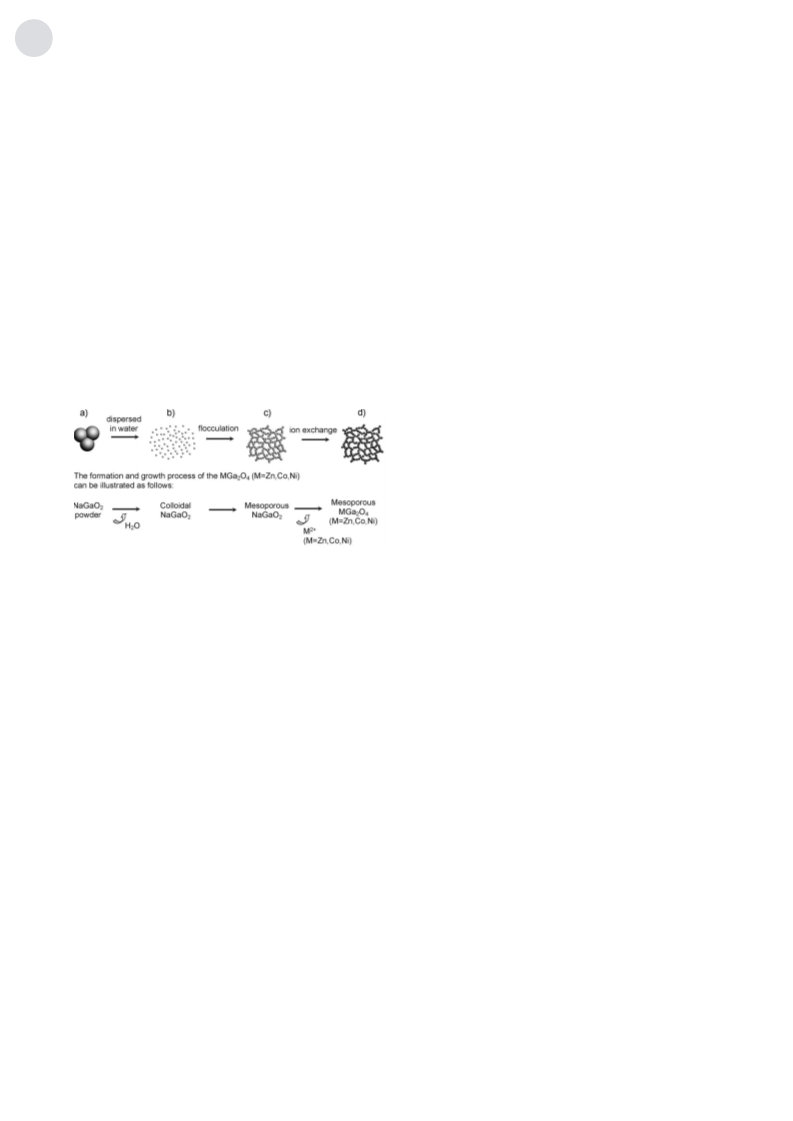
surfactant molecules. As illustrated in Figure 3, it seems
reasonable to speculate that the NaGaO2 powder dispersed in
Figure 3. Illustration of the formation of a mesoporous colloidal
template and an ion-exchange reaction based on the colloidal tem-
plate. a) NaGaO2 solid powder particles. b) NaGaO2 colloidal particles
obtained by dispersing the NaGaO2 powders in deionized water.
c) Formation of a mesoporous NaGaO2 colloidal template by floccu-
lation. d) Formation of mesoporous ZnGa2O4 by ion-exchange reaction
on the NaGaO2 colloidal template.
AB2O4-type oxides with spinel structure have potential
applications in many fields such as catalysis, gas sensors, and
photoelectronics. In particular, ZnGa2O4 is a transparent and
conductive material which should be useful for UV photo-
electronic devices.[12] ZnGa2O4 also shows potential as a
photocatalyst for wastewater treatment and hydrogen pro-
duction by water splitting.[13,14] Here meso-ZnGa2O4 was used
as a photocatalyst to convert CO2 into methane (CH4) under
irradiation of UV light.
water can form amorphous colloidal particles, which tend to
form the mesoporous NaGaO2 colloid by flocculation due to
the weak repulsion between the colloidal particles. The ion-
exchange process between Zn2+ and Na+ is expected to be due
to the NaGaO2 mesoporous framework, because ZnGa2O4
crystal particles could nucleate and grow there. The meso-
porous structure of the NaGaO2 colloid is maintained in the
generated ZnGa2O4 after ion exchange, probably because the
reaction rate is moderate. For the ZnGa2O4 particles sus-
pended in water, a high zeta potential of + 52.66 mV was
measured. The opposite sign of the charge of zeta potential
for the ZnGa2O4 particles and NaGaO2 colloidal particles
suggests that the particles attract each other. This would be
beneficial for maintaining the NaGaO2 mesoporous frame-
work during the ion-exchange reaction. Moreover, changes to
the pores in NaGaO2 may take place during phase trans-
formation due to a change in crystal structure. However, the
porous structure of NaGaO2 colloid can compensate for the
volume change by tuning the pore size. This may promote the
mesostructure of NaGaO2 being inherited by ZnGa2O4.
Carbon dioxide, which is released mainly by burning of
fossil fuels, is the primary cause of global warming. Convert-
ing CO2 into valuable hydrocarbons by means of solar energy
is one of the best solutions to both global warming and energy
shortage. Generally, CO2 can be photoreduced to CH4 in the
presence of water vapor by using a wide band gap semi-
conductor such as TiO2 as photocatalyst. The photogenerated
holes in the valence band oxidize water to generate hydrogen
ions by the reaction H2O ! 1=2 O2 þ 2 Hþ þ 2 eꢀ (Eroedox
=
0.82 V vs. NHE). The photogenerated electrons in the
conduction band reduce CO2 to CH4 by the reaction
CO2 þ 8 eꢀ þ 8 Hþ ! CH4 þ 2 H2O (Eroedox = ꢀ0.24 V vs.
NHE).[15] The electronic structure of ZnGa2O4 has been
calculated by using plane-wave-based density functional
theory.[14] The valence band was mainly composed of the O
2p orbitals, whereas the conduction band was formed by
hybridization of Ga 4s4p and Zn 4s4p orbitals. The band gap
of the as-prepared ZnGa2O4 was determined from the UV/Vis
ꢀ 2010 Wiley-VCH Verlag GmbH & Co. KGaA, Weinheim
Angew. Chem. Int. Ed. 2010, 49, 6400 –6404

 Yan, Shi Cheng