Journal of the American Chemical Society
Article
6
,11−13
14
irreversibly evolve O2,
CO , and CO upon oxidation at
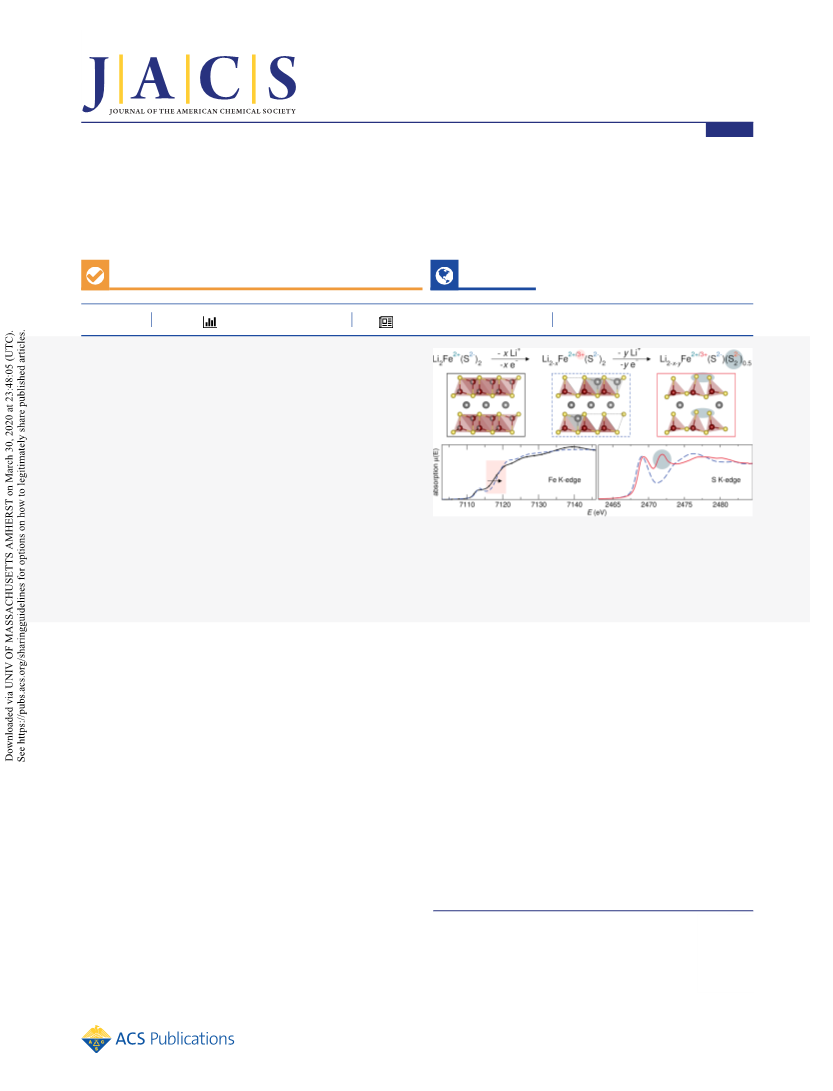
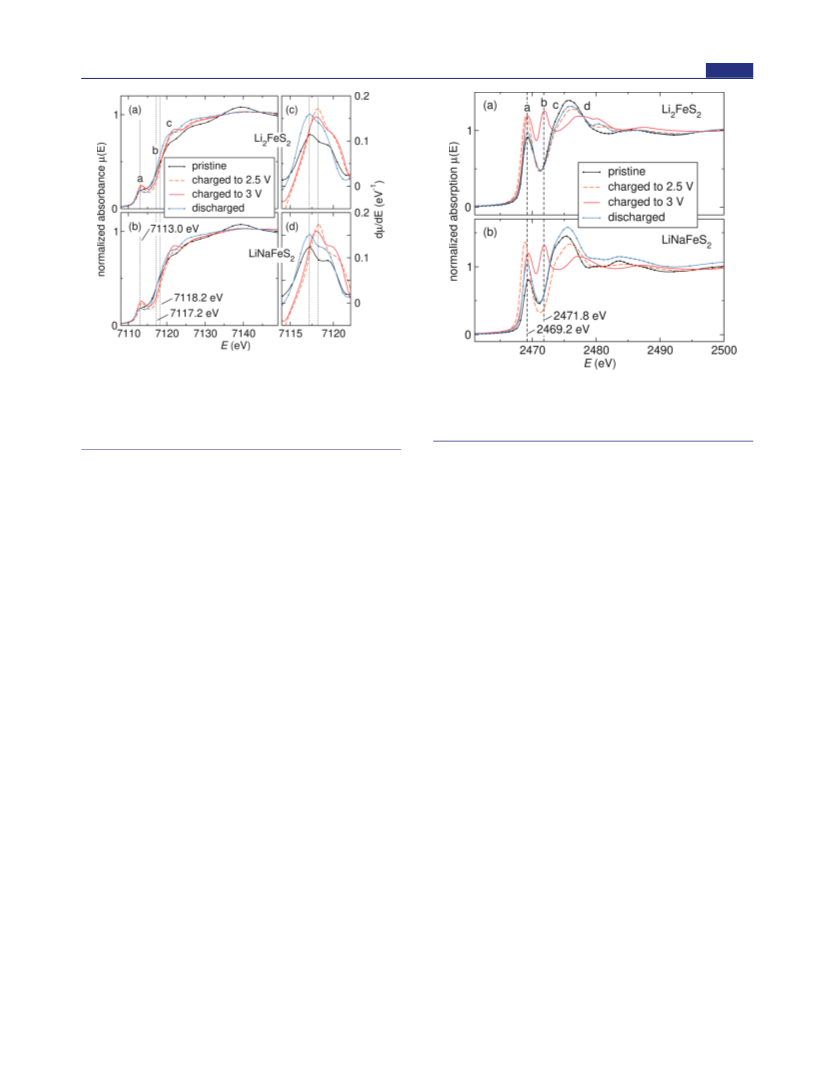
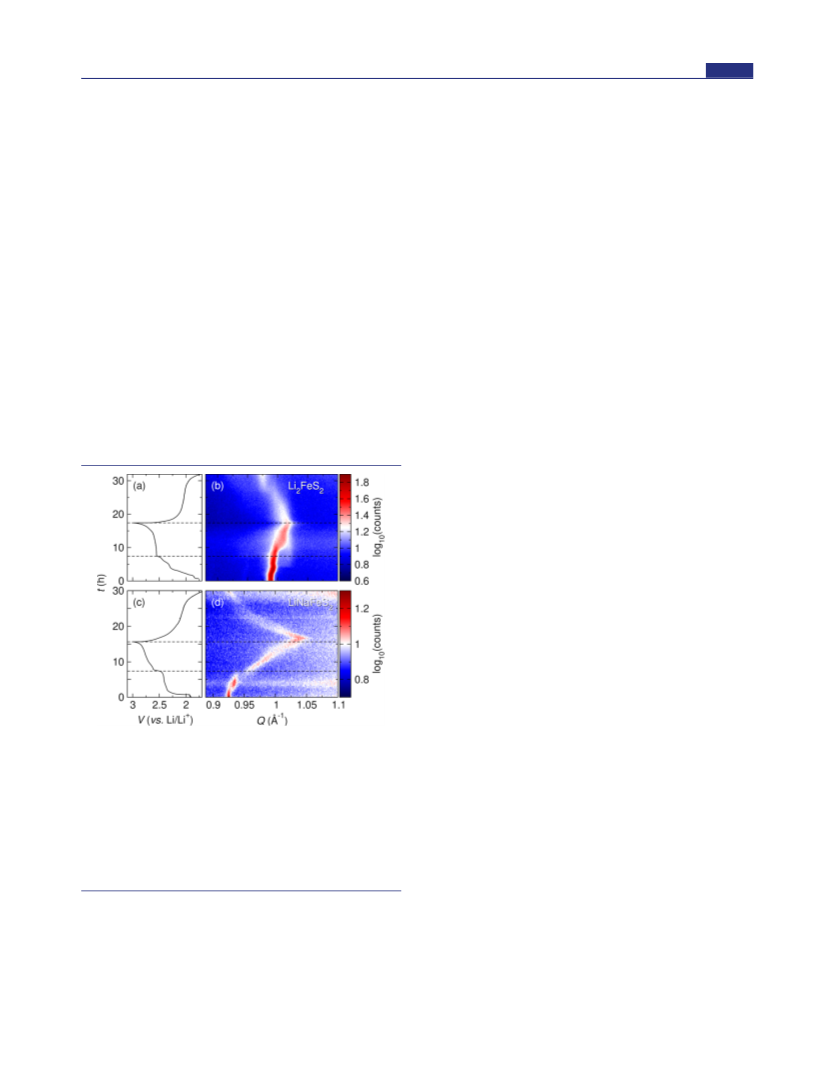
structural and spectroscopy data, we demonstrate that the
multielectron redox involves reversible cation and anion redox
in both materials.
2
high voltages. The nature of structural distortions, and even
direct oxygen-related characterization, in Li-rich oxide
materials at high states of charge remains unclear, in part
due to convolution of the data from electrolyte decomposition
at high potentials.
Because of the complications associated with the high
potentials required to access anion redox in oxides, we aim to
study anion redox in Li-rich materials within conventional
carbonate electrolyte stability windows. Sulfides are excellent
candidates, as sulfide oxidation occurs at potentials lower than
those required for oxide oxidation. Layered metal sulfides, such
EXPERIMENTAL SECTION
■
Materials Preparation. All materials and precursors were
handled inside an Ar-filled glovebox (H O and O <1 ppm).
2
2
Li FeS was prepared by solid-state synthesis, similar to the method
2
2
30
provided by Batchelor et al. Namely, powders of Li S (Beantown
2
Chemical, 99.9%), Fe (Acros Organics, 99.0%), and pyrite-FeS2
(
Sigma, 99.8%) were ground in stoichiometric quantities and pressed
into pellets of 200−300 mg with a hand-operated arbor press. Pellets
were placed inside carbon-coated vitreous silica ampules, evacuated to
≤10 mTorr, and sealed with a methane−oxygen torch without
15
as the canonical TiS identified by Whittingham in 1976,
2
16−23
have been studied at length as intercalation hosts.
sulfides have very recently regained interest in the community
to study anion redox. A few new alkali-rich sulfides have been
Li-rich
−
1
exposure to air. The ampule was heated at 5 °C min to 500 °C with
−1
a dwell time of 12 h and then heated at 1 °C min to 900 °C
2
4−26
27
followed by a dwell period of 16 h, during which the powders melt to
reported, including Li TiS ,
Li1.2Ti0.6S2,
and
2
3
2
8
form a molten reaction mixture. LiNaFeS was prepared similarly but
2
Li1.33−2x/3Ti0.67−x/3S2. Data to support anion redox in
Li1.33−2x/3Ti0.67−x/3S2 include shifts in the S L-edge and S K-
edge along with the appearance of a new feature in the S 2s
required lower temperatures for a complete reaction. Stoichiometric
8
28
region of the X-ray photoelectron spectra upon charging.
>
99.5%) were ground and pressed into pellets of up to 600 mg and
Saha et al. mentioned that the sulfide oxidation does not
necessarily cause persulfide bond formation and left the
subsequently sealed in evacuated vitreous silica ampules. The pellet
−
1
was heated in the ampule at 2 °C min to 500 °C for 96 h. After
ambient cooling to room temperature, the ampules were opened
inside the glovebox and the pellets were ground into fine, black
powders for further characterization.
Electrochemical Characterization. Electrode Fabrication. All
electrode preparation was performed either under Ar or in an Ar-filled
glovebox. Electrode slurries were prepared by suspending 50/40/10
2
−
n−
28
existence of S vs S (n < 2) open for debate.
2
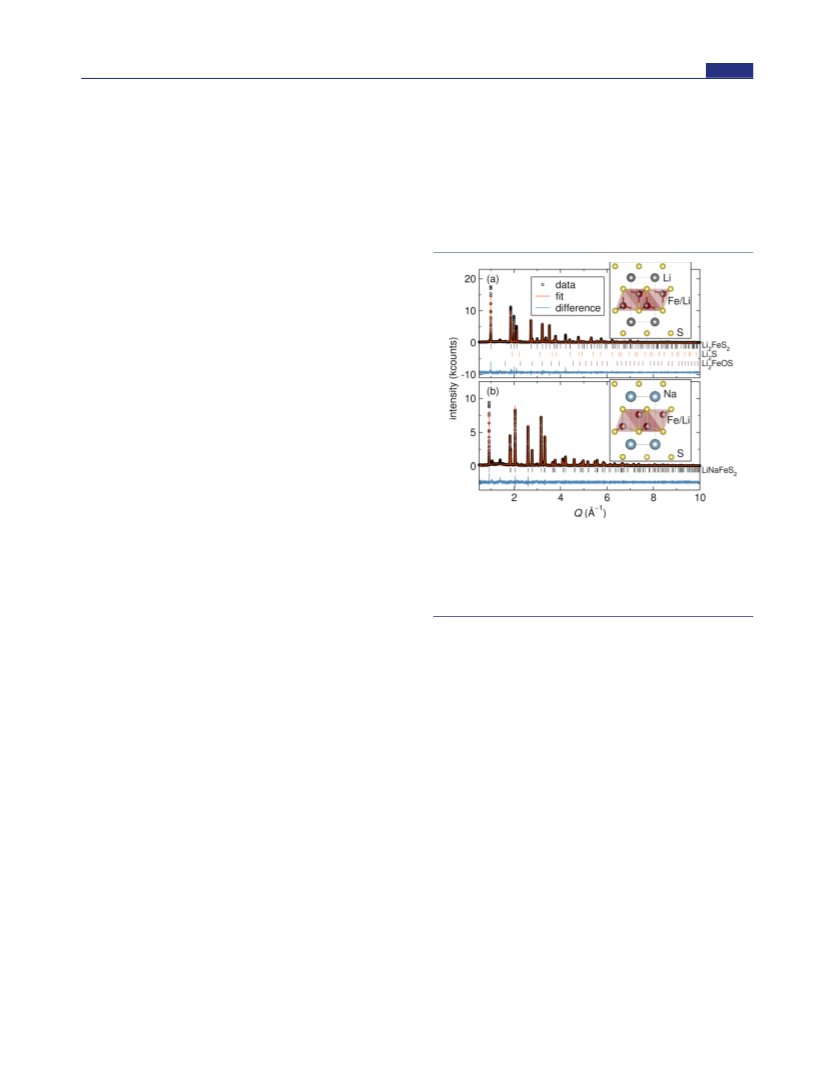
To study anion redox in sulfides, we turn to the original Li-
rich sulfide material: Li FeS . Li FeS was reported by Sharma
2
2
2
2
2
9
et al. in 1976. Li FeS crystallizes as a layered material. Li
2
2
occupies a layer of edge-sharing octahedral sites separated by a
30
layer of mixed Li/Fe edge-sharing tetrahedral sites. Early
(wt %) active material, conductive carbon (SuperP, Alfa Aesar,
31
reports suggested that Fe occupies the octahedral sites, but
>
9
99%), and PVDF binder (MTI), respectively, in cyclopentanone (ca.
times by mass of total solids) (Acros Organics, >99%) with a
Batchelor et al. reported definitive single-crystal diffraction
30
data to confirm the Fe is in fact in shared tetrahedral sites,
which is supported by Mossbauer spectroscopy, infrared
spectroscopy, and extended X-ray absorption fine structure
centrifugal mixer (Thinky USA). Electrodes were prepared by drop-
casting the slurry on 1/2 in. diameter carbon-coated Al foil current
collectors (MTI). The films were dried in a vacuum oven inside the
glovebox at 100 °C for at least 12 h, yielding an active material
loading of 1−3 mg on each electrode. Alternatively, to obtain higher
mass loadings, free-standing electrodes were prepared by hand
grinding 60/20/20 (wt %) active material, carbon (SuperP, Alfa
Aesar, >99%), and PTFE binder (Sigma, 1 μm powder), respectively,
into a film and pressing into 3/8 in. diameter electrodes under ca. 1
ton of force to yield electrodes of 10−20 mg (total).
̈
3
2
33
(
EXAFS) data (see Figure 1).
Early studies of the redox behavior of Li FeS were largely
2
2
3
4−36
separated into electrochemical experiments
ization of the chemically oxidized material.
and character-
3
2,34,37
The
−
1
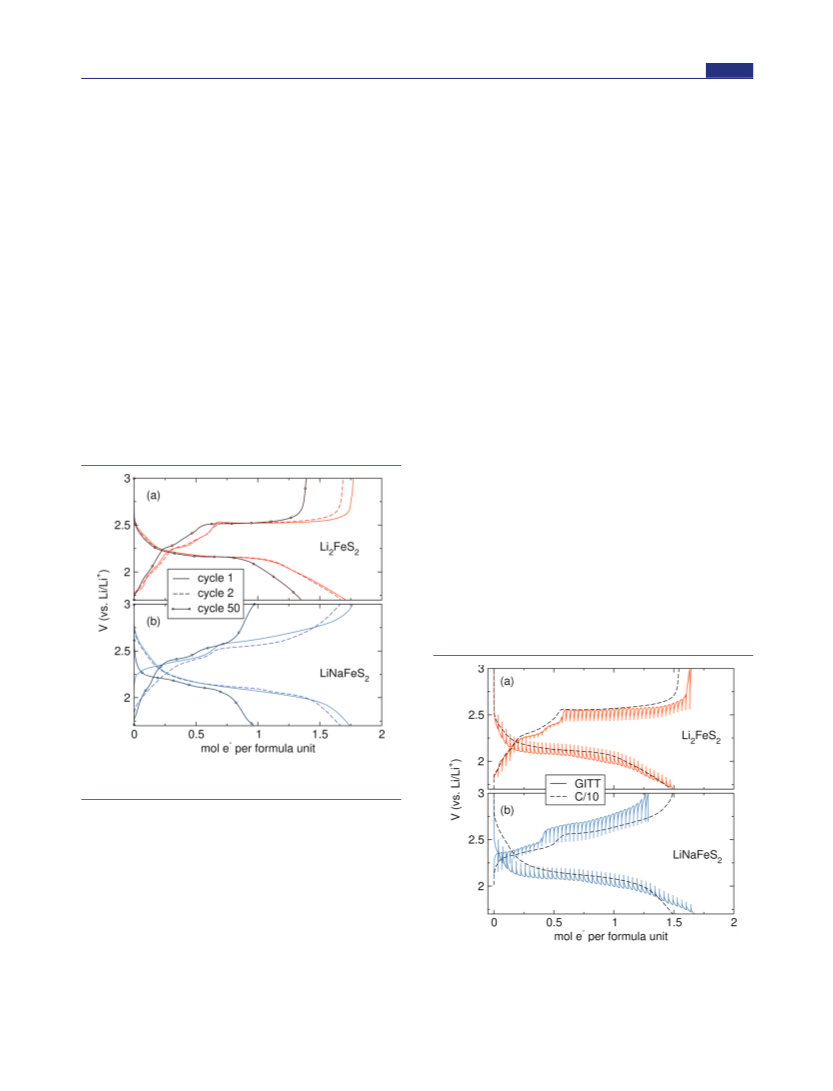
theoretical capacity of Li FeS is 400 mAh g , assuming a
2
2
−
2
e oxidation per formula unit. Previous studies have shown
−
electrochemical oxidation between 1.5 and 2 mol of e per
formula unit,
Electrochemical Testing. All electrochemical cells were assembled
inside an Ar-filled glovebox (H O and O <1 ppm). All electro-
3
6,38
making Li FeS a good material system to
2 2
2
2
study multielectron redox. Li FeS has also been used as a
cathode in full cell geometries with a graphite anode. The
chemistry unless otherwise noted was performed in 2032 coin cells
(MTI) with a Li-foil anode (Sigma, 99.9%, 0.75 mm, mechanically
cleaned immediately before cell assembly), polypropylene separator
(Celgard 2400), ca. 4 drops of electrolyte (55 ± 9 mg), and a working
electrode of 50 wt % active material as described above. The
2
2
38
oxidation mechanism has been suggested to involve first a
2
+
single-phase deintercalation of Li, resulting in some Fe
3
+
oxidation to Fe , followed by a two-phase oxidation, resulting
in S oxidation to S . Infrared spectroscopy on chemically
2−
2−
electrolyte was prepared as a 1 M solution of LiPF (Oakwood
6
2
Chemical, Battery grade) in a 3/1/1 (by volume) mixture of ethylene
carbonate, dimethyl carbonate (DMC), and propylene carbonate
delithiated samples suggests persulfide moieties form with
32
oxidation of greater than one electron per formula unit.
Assignments of the Mossbauer spectra suggest that chemical
oxidation by <1e (i.e., in the range 0 ≤ x ≤ 1 in Li −xFeS2)
(
PC) (all Sigma, ≥99%). The solution was prepared in a dried HDPE
̈
bottle by mixing of the carbonates and addition of the salt. The
electrolyte was used for no more than 2 weeks before a new solution
was prepared. The liquid carbonates (DMC and PC) were stored over
activated molecular sieves (3 Å, Beantown Chemical) prior to use.
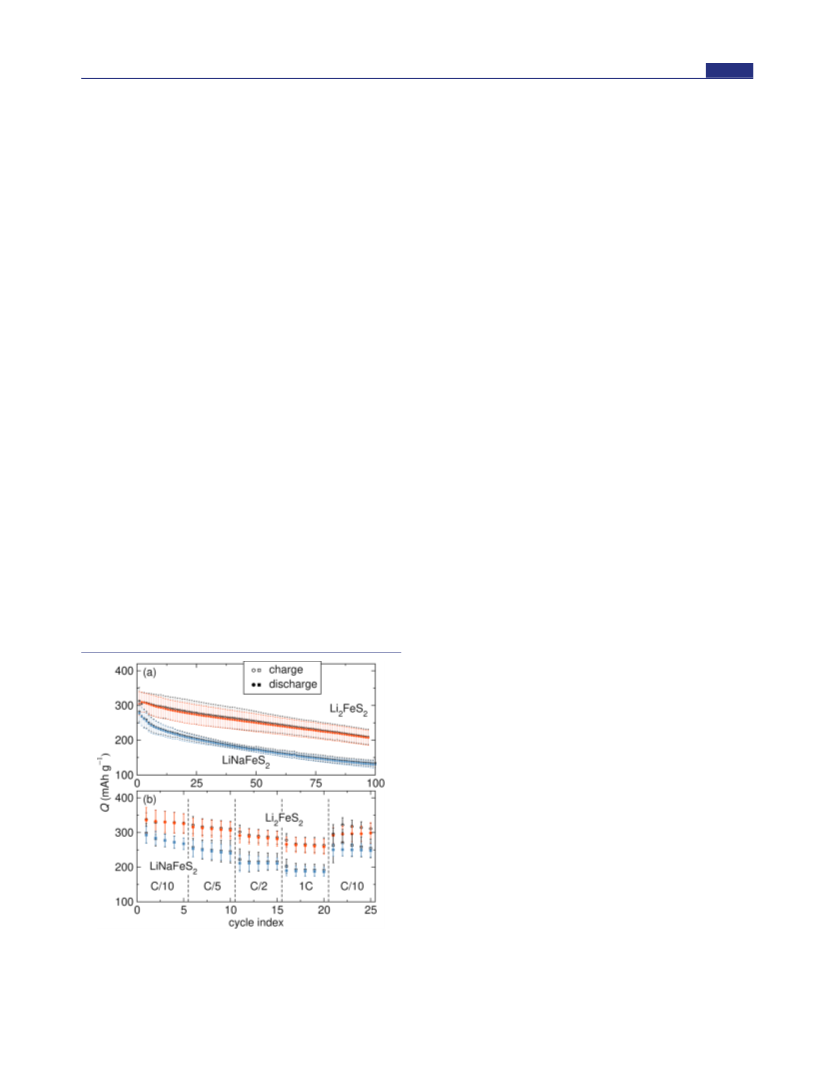
Both Li FeS and LiNaFeS were charged (oxidized) at the rate
indicated (based on 1e per formula unit) to 3 V and discharged at
the rate indicated to 1.7 V. In some cases, a lower oxidation cutoff
potential (e.g., 2.5 V) was used as noted. All voltages are vs the Li
−
2
2
+/3+
proceeds through the Fe
couple, with no further oxidation
4
+
35,37
to Fe even up to removal of 2 electrons.
More recent
work on the material has focused on varied syntheses of
2
2
2
−
Li FeS , aiming to utilize lower temperatures or different
2
2
3
8,39
precursors.
Along with Li FeS , we report the new isostructural phase
2
2
+
metal anode, which is assumed to be at the Li/Li reference potential.
+
LiNaFeS . Na is a larger monovalent cation in comparison to
2
All electrochemical experiments were performed with either a VMP3
multichannel potentiostat (Bio-Logic) or BCS 805 battery cycler
+
Li and therefore preferentially occupies the octahedral site.
Both materials support oxidation at greater than one electron
per Fe, providing a basis to study the possibility of anion redox.
By correlating the electrochemical performance with detailed
(
Bio-Logic). The current in the GITT experiments was C/10 on the
basis of one electron per formula unit for 20 min separated by 4 h rest
periods.
B
J. Am. Chem. Soc. XXXX, XXX, XXX−XXX

 Hansen, Charles J.