9912 J. Phys. Chem. B, Vol. 102, No. 49, 1998
Medeiros and Zoski
2
TABLE 3: Current Densities (mA/cm ) at Pure Aluminum,
XA5-P Aluminum Alloy, and DF50V Aluminum Alloy for
Each Catholyte Concentration at the Designated
Temperaturea
aluminum, and DF50V aluminum, respectively. The standard
deviation is indicated by the ( value. The numbers with
asterisks (*) signify the highest current density achieved before
passivation.
temp
The first number under each temperature in Table 3 corre-
sponds to current densities recorded at a pure aluminum anode.
For this anode, there is no activation at any of the designated
temperatures; aluminum passivation occurs at current densities
NaOCl
Al sample
45 °C
55 °C
65 °C
80 °C
0.35 M
0.70 M
1.40 M
pure Al
XA5-P
DF50V
pure Al
XA5-P
DF50V
pure Al
XA5-P
DF50V
*30 ( 1 *35 ( 1 *35 ( 3 *48 ( 1
200 ( 1 220 ( 3 220 ( 2 260 ( 1
200 ( 4 200 ( 5 275 ( 2 320 ( 4
*28 ( 1 *25 ( 0 *22 ( 2 *22 ( 3
280 ( 3 350 ( 3 400 ( 3 440 ( 7
340 ( 1 360 ( 4 440 ( 1 480 ( 4
*50 ( 1 *48 ( 2 *48 ( 2 *50 ( 1
550 ( 6 560 ( 7 680 ( 3 700 ( 8
600 ( 4 650 ( 6 690 ( 1 780 ( 4
2
between 22 and 50 mA/cm . Thus, some type of impermeable
layer must be forming on the surface of pure aluminum to show
passivation at all temperatures and NaOCl concentrations
considered. The exact nature of the surface layer is under
investigation.
Current densities are significantly larger for aluminum alloy
XA5-P, as shown by the second number under each temperature
in Table 3. No passivation was observed at the three NaOCl
concentrations and four temperatures considered. At a specific
NaOCl concentration, there was an approximate 1.1-fold
increase in current density for each 10 °C increase in temper-
ature. However, the effect of NaOCl concentrations at indi-
vidual temperatures led to an approximate 1.6-fold increase in
current density from 0.35 to 0.70 M NaOCl and a 1.7-fold
increase from 0.70 to 1.40 M. A 4-fold change in NaOCl
concentration from 0.35 to 1.40 M led to an approximate 2.8-
fold increase in current density at each specified temperature.
For aluminum alloy DF50V, current densities are indicated
by the third number under each temperature in Table 3. These
current densities are generally slightly larger than those observed
for XA5-P. Similar to the case for alloy XA5-P, no passivation
was observed at the three NaOCl concentrations and four
temperatures considered, and the increase in current density was
approximately 1.1-fold at a specific NaOCl concentration.
Additionally, the effect of NaOCl concentrations at individual
temperatures led to an approximate 1.6-fold increase in current
density from 0.35 to 0.70 M NaOCl and a 1.7-fold increase
from 0.70 to 1.40 M. A 4-fold change in NaOCl concentration
from 0.35 to 1.40 M led to an approximate 2.8-fold increase in
current density at each specified temperature. These observa-
tions were also noted for XA5-P.
a
An * is used to indicate where passivation occurred. ( signifies
the standard deviation.
2
density of 1500 ( 9 mA/cm was observed in 5.0 M NaOH at
8
0 °C, where no passivation occurred.
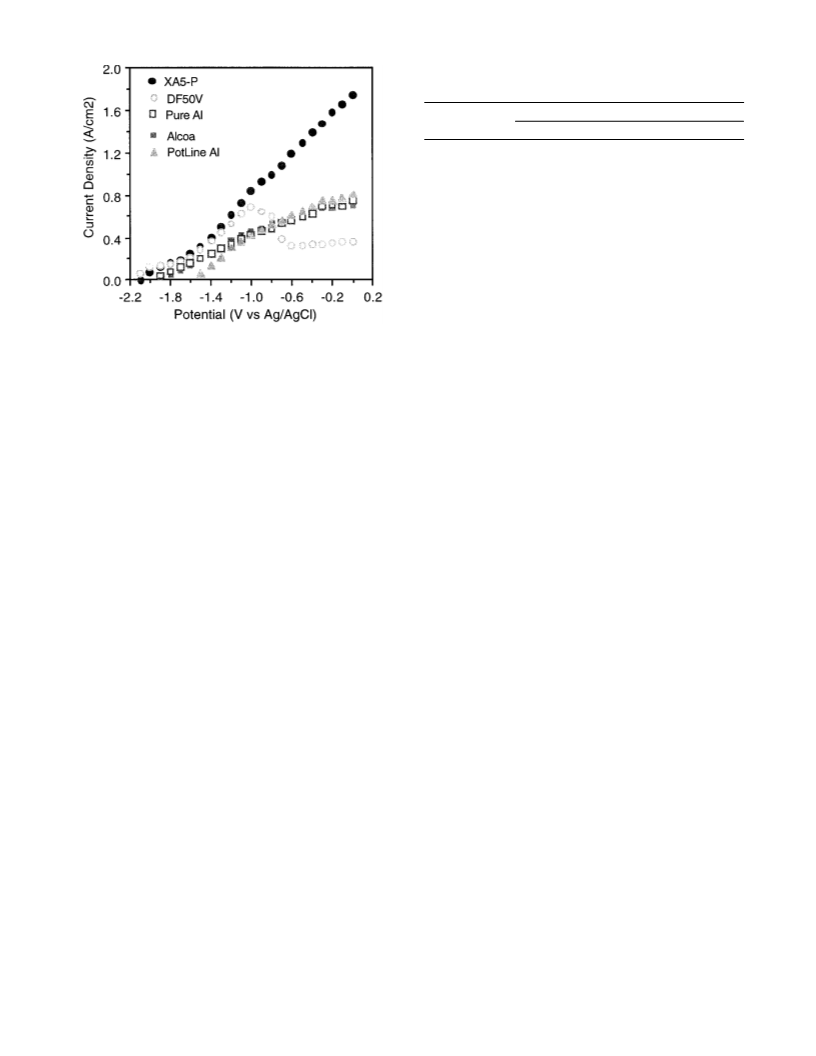
There is a clear trend of an increase in current density, and
hence activation, with temperature at NaOH concentrations
evaluated for XA5-P aluminum, pure aluminum, Alcoa alumi-
num, and potline aluminum. For DF50V aluminum, current
density remained essentially the same at 45 and 55 °C before
increasing at 65 and 80 °C in 3.0 M NaOH. In 5.0 M NaOH,
there was an increase in current density with temperature at the
DF50V aluminum anode. The behavior of DF50V aluminum
in 8.0 M NaOH was sporadic as the temperature increased.
In general, experiments performed at the 8.0 M NaOH level
resulted in a decrease in current density of the aluminum samples
evaluated at a specific temperature. At 80 °C, slight enhance-
ments in current density were observed over those at 65 °C.
Overall, maximum current densities occurred in the presence
of 3.0 and 5.0 M NaOH and at the temperatures 55 and 65 °C.
Of the aluminum samples evaluated, aluminum alloy XA5-P
outperformed the others. Alloy DF50V passivated the most as
the NaOH concentration and temperature were changed; the only
exceptions occurred at 80 °C in 3.0 and 5.0 M NaOH. Pure
aluminum, potline aluminum, and Alcoa aluminum samples
performed similarly and exhibited the lowest current densities
as NaOH concentration and temperature were varied.
The enhanced cell performance observed for XA5-P can be
attributed to the greater percentage of gallium than found in
DF50V. Although gallium is also present in Alcoa aluminum,
the presence of many other additives appears to hinder the cell
performance of this sample. Potline aluminum did not perform
well under the test conditions due to its impure state.
Pure aluminum also demonstrated lower current densities.
However, the monitoring of its performance was continued in
order to serve as a benchmark against which XA5-P and DF50V
could be compared as catholyte concentrations and electrocata-
lysts were investigated.
The data in Table 3 demonstrate that none of the NaOCl
concentrations considered are large enough at any temperature
to activate the pure aluminum anode. However, NaOCl
concentrations of 0.7 and 1.4 M do show current densities
2
between 440 and 780 mA/cm at 80 °C for aluminum alloys
XA5-P and DF50V. Since these current densities are not large
enough for high-rate applications where current densities greater
2
than 1000 mA/cm are required, the effect of both NaOH and
NaOCl on current density magnitude was investigated for
increases in current density.
NaOCl and NaOH Concentration Effects. Table 4 sum-
marizes the polarization results for XAP-5 Al, DF50V Al, and
pure aluminum at 55 °C as a function of NaOCl concentration
in the absence and presence of 3.0 M NaOH. For each
aluminum sample and for a specific NaOCl concentration, two
current densities are listed which correspond to the measured
current densities in the presence of 0 M NaOH and 3.0 M
NaOH, respectively. The numbers with asterisks (*) represent
the highest current density achieved before passivation, and (
signifies the standard deviation.
Catholyte Concentration Characterization. A series of
experiments at the temperatures 45, 55, 65, and 80 °C were
performed to determine an optimum NaOCl concentration in
the absence of NaOH. NaOCl concentrations of 0.35, 0.70, and
.40 M were used in the presence of seawater. Pure aluminum,
XA5-P aluminum, and DF50V aluminum served as the anode.
Polarization graphs similar to Figure 3 were generated. Table
1
3
summarizes the polarization results. The highest current
densities achieved during the polarization experiments are
recorded as a function of temperature and catholyte concentra-
tion. Thus, for each NaOCl concentration and for a specific
temperature, three current densities are listed which correspond
to the measured current densities at pure aluminum, XA5-P
For XAP-5 aluminum, catholyte alone activates the anode to
2
a current density of 220 mA/cm compared to the passivation
2
which occurs at a current density of 620 mA/cm in the presence
of 3.0 M NaOH only. When a combination of 0.35 M NaOCl
and 3.0 M NaOH is used, no passivation occurs and a

 Medeiros, Maria G.