20
S.-W. Liang et al. / Journal of Molecular Structure 875 (2008) 17–21
are connected by apt via its two triazole nitrogen atoms
N(1) and N(2), leading to the formation of a 2D polymeric
network with large hexagonal channels. In previous
reports, monodentate and chelating N-donor ligands were
frequently used as co-ligands in preparing copper cyanide
coordination polymers. Such designs often led to the for-
mation of one-dimensional chains [14,15]. The complex 1
is exampled that 2D or 3D copper cyanide coordination
polymers can be expected when multidentate bridging
ligand is selected as co-ligand.
between two adjacent [Cu(SCN)]n ladder-like chains, which
extends the structure to a two-dimensional polymeric
framework. Such structure is rare in previous reports.
Using apt as ligand, only tetranuclear Ag(I) complex is pre-
pared and structurally characterized to date [17].
3.2. Thermal stability and fluorescent properties
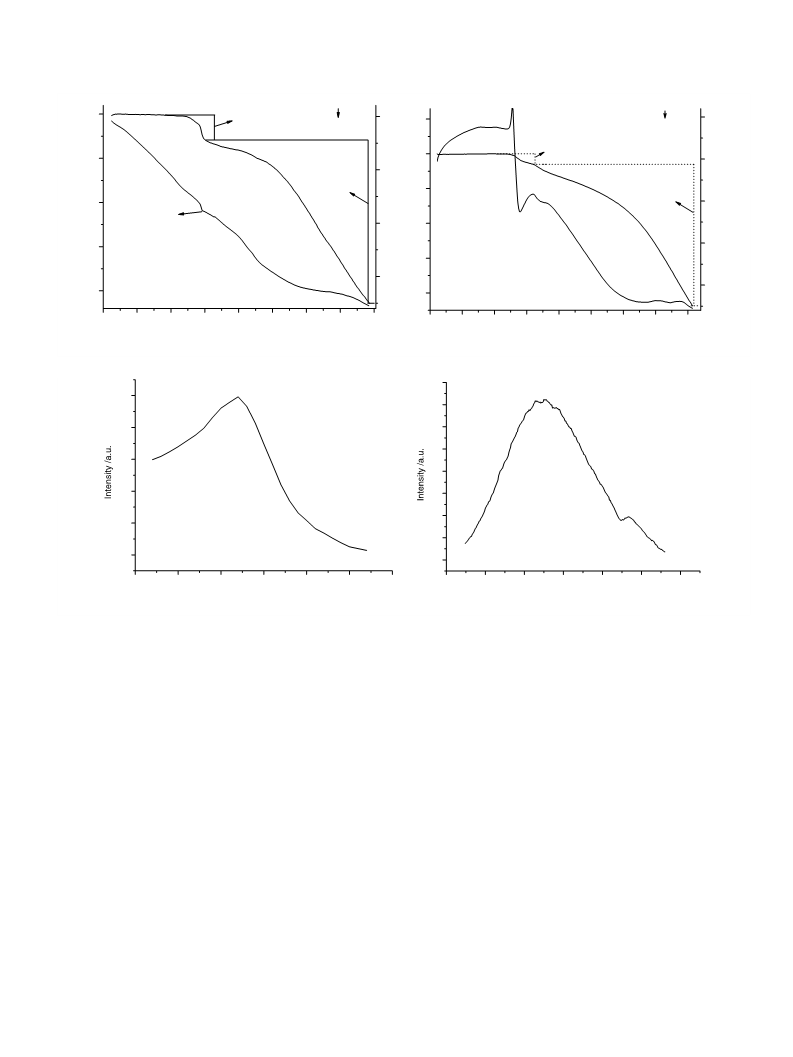
Thermal analyses for complexes 1 and 2 were performed
in the temperature range of 20–800 ꢁC. As shown in Fig. 3,
the complexes 1 and 2 are stable up to 250 ꢁC without
weight-loss. Complex 1 decomposed rapidly near 300 ꢁC
with 5.70% weight-loss, and then decomposed continuously
to 800 ꢁC with 36.89% weight-loss. The final residue is CuO
(found: 57.41%, calc.: 58.53%). Complex 2 showed an
endothermic maximum at 255.7 ꢁC without weight-loss
indicated a phase transfer process happened. This phenom-
enon is also observed in [Cu3(CN)3(phen)]n complex [5]. In
the temperature range of 270–800 ꢁC, complex 2 decom-
posed successively with the final 56.01% residue left, which
may be a mixture of CuO and CuSO4 [18].
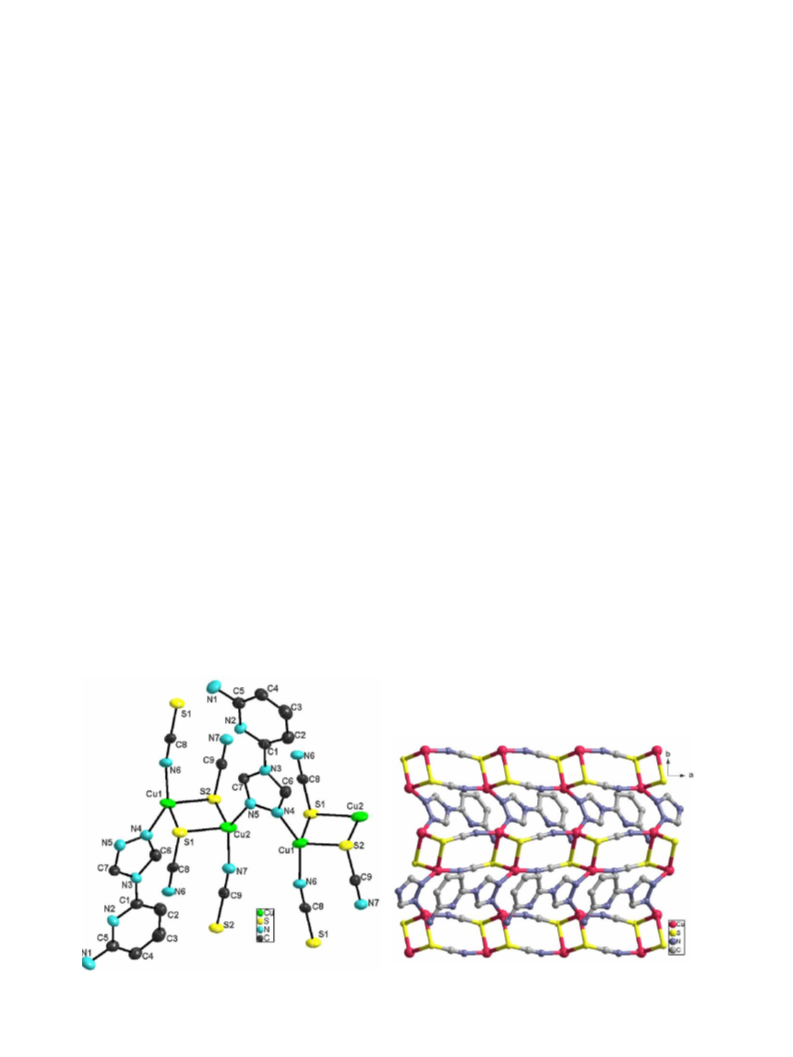
The complex 2 exhibits two-dimensional polymeric
structure as shown in Fig. 2. The asymmetric structure unit
consists of two crystallographically independent copper(I)
atoms, one apt, and two thiocyanate ligands. Both cop-
per(I) atoms adopt distorted tetrahedral geometry, coordi-
nated by one nitrogen atom and two bridging sulfur atoms
from three l3-thiocyanate groups, and one nitrogen atom
from the triazole group of apt. The bond lengths of
˚
Cu(1)–S(1) and Cu(1)–S(2) are 2.4279(11), 2.6236(11) A,
while those of Cu(2)–S(1) and Cu(2)–S(2) are 2.8068(11),
˚
2.3378(11) A, respectively. Cu(1) and Cu(2) atoms are
linked by two bridging S atoms to form a Cu2S2 dimmer.
The bond angles of Cu(1)–S(1)–Cu(2) and Cu(1)–S(2)–
Cu(2) are 69.53(3), 74.19(3)ꢁ, while S(1)–Cu(1)–S(2) and
S(1)–Cu(2)–S(2) are 109.74(4), 106.55(4)ꢁ, respectively.
Such Cu2S2 dimmers are further linked by linear thiocya-
nate groups to form ladder-like [Cu(SCN)]n chains. The
bond lengths of Cu(1)–N(6) and Cu(2)–N(7) are 1.906(3),
In the solid state, complexes 1 and 2 show strong fluo-
rescent emission bands centered at 387 and 525 nm, respec-
tively, under photoexcitation of 356 nm (Fig. 4). Generally,
metal-to-ligand charge transfer (MLCT) is the most com-
mon assignment for the fluorescent emission of copper(I)
cyanide complexes [6]. The fluorescent emission of complex
1 is assigned to metal-to-ligand charge transfer where the
electron is transferred from Cu(I) ion to p* orbital of cya-
nide group [19]. The emission band of complex 2 is obvi-
ously different with the one of complex 1. This
phenomenon is observed in several copper(I) thiocyanate
coordination polymers such as [Cu2(SCN)2(dmpz)]n
(582 nm) and [Cu2(SCN)2(dps)]n (538 nm), and the most
possible assignment for these emissions originates from
ligand-to-metal charge transfer (LMCT) [8,9].
˚
1.907(3) A, respectively. Generally, thiocyanate acts as
counter anion or monodentate ligand in metal complexes
[16]. Thiocyanate acting as tridentate ligand is rarely
observed and only found in copper(I) complexes [8,9].
On the other hand, apt acts as bidentate ligand in com-
plex 2. Amino nitrogen atom of apt is uncoordinated,
which is different with the structure of complex 1. The
triazole group of apt binds to two copper(I) centers
Fig. 2. Views of asymmetric structural unit and 2D polymeric network of 2.

 Liang, Sheng-Wen