Welcome to LookChem.com Sign In|Join Free
  • or

Encyclopedia

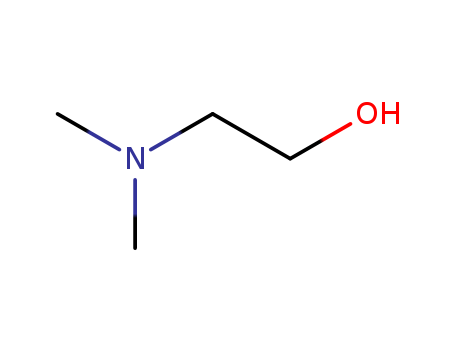
N,N-Dimethylethanolamine

Base Information
  • Chemical Name:N,N-Dimethylethanolamine
  • CAS No.:108-01-0
  • Deprecated CAS:116134-09-9,156681-25-3,1404326-81-3
  • Molecular Formula:C4H11NO
  • Molecular Weight:89.1374
  • Hs Code.:2922.19 Oral rat LD50: 2000 mg/kg
  • European Community (EC) Number:203-542-8
  • ICSC Number:0654
  • NSC Number:2652
  • UN Number:2051
  • UNII:2N6K9DRA24
  • DSSTox Substance ID:DTXSID2020505
  • Nikkaji Number:J5.068G
  • Wikipedia:Dimethylethanolamine
  • Wikidata:Q241049
  • NCI Thesaurus Code:C72733
  • RXCUI:3116
  • Metabolomics Workbench ID:45347
  • ChEMBL ID:CHEMBL1135
  • Mol file:108-01-0.mol
N,N-Dimethylethanolamine

Synonyms:(2-Hydroxyethyl)dimethylamine;(Dimethylamino)ethanol;(N,N-Dimethylamino)ethanol;2-(Dimethylamino)ethanol;2-(Dimethylamino)ethyl alcohol;2-(N,N-Dimethylamino)ethanol;Amietol M 21;Dimethyl(2-hydroxyethyl)amine;Dimethyl(hydroxyethyl)amine;Dimethylethanolamine;Dimethylmonoethanolamine;N,N-Dimethyl(2-hydroxyethyl)amine;N,N-Dimethyl-2-aminoethanol;N,N-Dimethyl-N-(b-hydroxyethyl)amine;N,N-Dimethyl-b-hydroxyethylamine;N-(2-Hydroxyethyl)-N,N-dimethylamine;N-(2-Hydroxyethyl)dimethylamine;b-Dimethylaminoethyl alcohol;b-Hydroxyethyldimethylamine;

Suppliers and Price of N,N-Dimethylethanolamine
Supply Marketing:
Business phase:
The product has achieved commercial mass production*data from LookChem market partment
Manufacturers and distributors:
  • Manufacture/Brand
  • Chemicals and raw materials
  • Packaging
  • price
  • TCI Chemical
  • 2-(Dimethylamino)ethanol
  • 25ML
  • $ 18.00
  • TCI Chemical
  • 2-(Dimethylamino)ethanol
  • 500ML
  • $ 25.00
  • Sigma-Aldrich
  • 2-Dimethylaminoethanol ≥99.5%
  • 2l
  • $ 96.10
  • Sigma-Aldrich
  • 2-Dimethylaminoethanol analytical reference material
  • 1ml
  • $ 73.10
  • Sigma-Aldrich
  • 2-Dimethylaminoethanol purum, ≥98.0% (GC)
  • 1l
  • $ 58.00
  • Sigma-Aldrich
  • 2-Dimethylaminoethanol purified by redistillation, ≥99.5%
  • 100ml
  • $ 54.80
  • Sigma-Aldrich
  • 2-(Dimethylamino)-ethanol for synthesis
  • 25 kg
  • $ 434.75
  • Sigma-Aldrich
  • 2-Dimethylaminoethanol purified by redistillation, ≥99.5%
  • 800ml
  • $ 320.00
  • Sigma-Aldrich
  • 2-Dimethylaminoethanol ≥99.5%
  • 18l
  • $ 504.00
  • Sigma-Aldrich
  • 2-(Dimethylamino)-ethanol for synthesis. CAS 108-01-0, chemical formula (CH ) NCH CH OH., for synthesis
  • 8032379025
  • $ 454.00
Total 29 raw suppliers
Chemical Property of N,N-Dimethylethanolamine
Chemical Property:
  • Appearance/Colour:clear to pale yellow liquid 
  • Vapor Pressure:100 mm Hg ( 55 °C) 
  • Melting Point:-70 °C 
  • Refractive Index:n20/D 1.4294(lit.)  
  • Boiling Point:135 °C at 760 mmHg 
  • PKA:pK1:9.26(+1) (25°C) 
  • Flash Point:40.6 °C 
  • PSA:23.47000 
  • Density:0.897 g/cm3 
  • LogP:-0.45970 
  • Storage Temp.:Flammables area 
  • Sensitive.:Hygroscopic 
  • Solubility.:alcohol: miscible(lit.) 
  • Water Solubility.:miscible 
  • XLogP3:-0.4
  • Hydrogen Bond Donor Count:1
  • Hydrogen Bond Acceptor Count:2
  • Rotatable Bond Count:2
  • Exact Mass:89.084063974
  • Heavy Atom Count:6
  • Complexity:28.7
  • Transport DOT Label:Corrosive Flammable Liquid
Purity/Quality:

99%, *data from raw suppliers

2-(Dimethylamino)ethanol *data from reagent suppliers

Safty Information:
  • Pictogram(s): Corrosive
  • Hazard Codes:
  • Statements: 10-20/21/22-34 
  • Safety Statements: 25-26-36/37/39-45 
MSDS Files:

SDS file from LookChem

Total 1 MSDS from other Authors

Useful:
  • Chemical Classes:Nitrogen Compounds -> Ethanolamines
  • Canonical SMILES:CN(C)CCO
  • Inhalation Risk:No indication can be given about the rate at which a harmful concentration of this substance in the air is reached on evaporation at 20 °C.
  • Effects of Short Term Exposure:The substance is severely irritating to the respiratory tract. The substance is corrosive to the eyes and skin. Corrosive on ingestion. Inhalation of the vapour may cause lung oedema. The effects may be delayed. Medical observation is indicated.
  • Uses dimethyl MEA (DMAE) is also known as dimethylaminoethanol. Studies indicate skin-firming properties, and an ability to reduce the appearance of fine lines and wrinkles as well as dark circles under the eyes. It is considered anti-aging, and antiinflammatory, and has exhibited free-radical scavenging activity. 2-(Dimethylamino)ethanol is used as corrosion inhibitor, anti-scaling agent, paint additive, coating additive and solids separation agent. It is also used as an intermediate for active pharmaceutical ingredients and dyes. It serves as a curing agent for polyurethanes and epoxy resins. Further, it is used as an additive to boiler water. In addition to this, it is used therapeutically as a CNS stimulant. 2-Dimethylaminoethanol (deanol, DMAE) may be employed as a ligand in the copper-catalyzed amination of aryl bromides and iodides.
Technology Process of N,N-Dimethylethanolamine

There total 88 articles about N,N-Dimethylethanolamine which guide to synthetic route it. The literature collected by LookChem mainly comes from the sharing of users and the free literature resources found by Internet computing technology. We keep the original model of the professional version of literature to make it easier and faster for users to retrieve and use. At the same time, we analyze and calculate the most feasible synthesis route with the highest yield for your reference as below:

synthetic route:
Guidance literature:
With potassium chloride; In methanol; at 24.9 ℃; Rate constant; Kinetics; Mechanism; different pH values from 298-323 K, different ion strength of KCl solution;
DOI:10.1007/BF00765971
Refernces

Novel metallophthalocyanines bearing 3-(p-chlorophenyl)-5-p-tolyl-4H-1,2,4-triazole bulky substituents by microwave irradiation

10.1016/j.jorganchem.2008.08.007

This study focuses on the synthesis and characterization of novel metallophthalocyanines bearing 1,2,4-triazole macromolecular substituents, which have important biological properties and potential applications in magnetochemical and optical sensing. This study involves the preparation of metallophthalocyanines [6–9; M = Ni(II), Zn(II), Co(II), and Cu(II)] using a series of chemical reactions starting from ethyl p-chlorobenzoylhydrazone (1) and passing through several intermediate compounds to finally obtain metallophthalocyanines 6–9. The synthesis was carried out under microwave irradiation and using reagents such as dimethylaminoethanol and anhydrous metal salts. The new compounds were characterized using a variety of analytical techniques including infrared (IR) spectroscopy, proton and carbon-13 nuclear magnetic resonance (1H NMR and 13C NMR), ultraviolet-visible (UV-Vis) spectroscopy and elemental analysis, as well as thermogravimetric analysis (TGA) to determine their thermal stability.

Post a RFQ

Enter 15 to 2000 letters.Word count: 0 letters

Attach files(File Format: Jpeg, Jpg, Gif, Png, PDF, PPT, Zip, Rar,Word or Excel Maximum File Size: 3MB)

1 Customer Service

What can I do for you?
Get Best Price

Get Best Price for 108-01-0