Tetrahedron Letters
Highly efficient oxidation of benzyl alcohols using the catalytic system
sulfoxide/oxo-complexes
⇑
Sara C. A. Sousa, Joana R. Bernardo, Ana C. Fernandes
Centro de Química Estrutural, Instituto Superior Técnico, Universidade Técnica de Lisboa, Av. Rovisco Pais, 1049-001 Lisboa, Portugal
a r t i c l e i n f o
a b s t r a c t
Article history:
This work reports a novel and highly efficient method for the oxidation of benzyl alcohols to the corre-
Received 14 June 2012
Revised 28 August 2012
Accepted 31 August 2012
Available online 8 September 2012
sponding aldehydes catalyzed by HReO
4
(5 mol %) using 4-methylphenyl sulfoxide as the oxidizing agent.
Ó 2012 Elsevier Ltd. All rights reserved.
Keywords:
Oxidation
Benzyl alcohols
Aldehydes
Oxo-complexes
Sulfoxides
The synthesis of aldehydes is a fundamental process in Organic
Chemistry, in particular, for the chemical and pharmaceutical
industries, where aldehydes find wide applications as intermedi-
ates. The Swern oxidation (using DMSO coupled with the electro-
phile oxalyl chloride) is an efficient and widely used method for
the oxidation of alcohols.1 However, these reagents bring some
disadvantages: the by-product dimethyl sulfide is volatile (bp
cation we report the selective oxidation of benzyl alcohols to the
corresponding aldehydes catalyzed by oxo-complexes using a sulf-
oxide as the oxidizing agent.
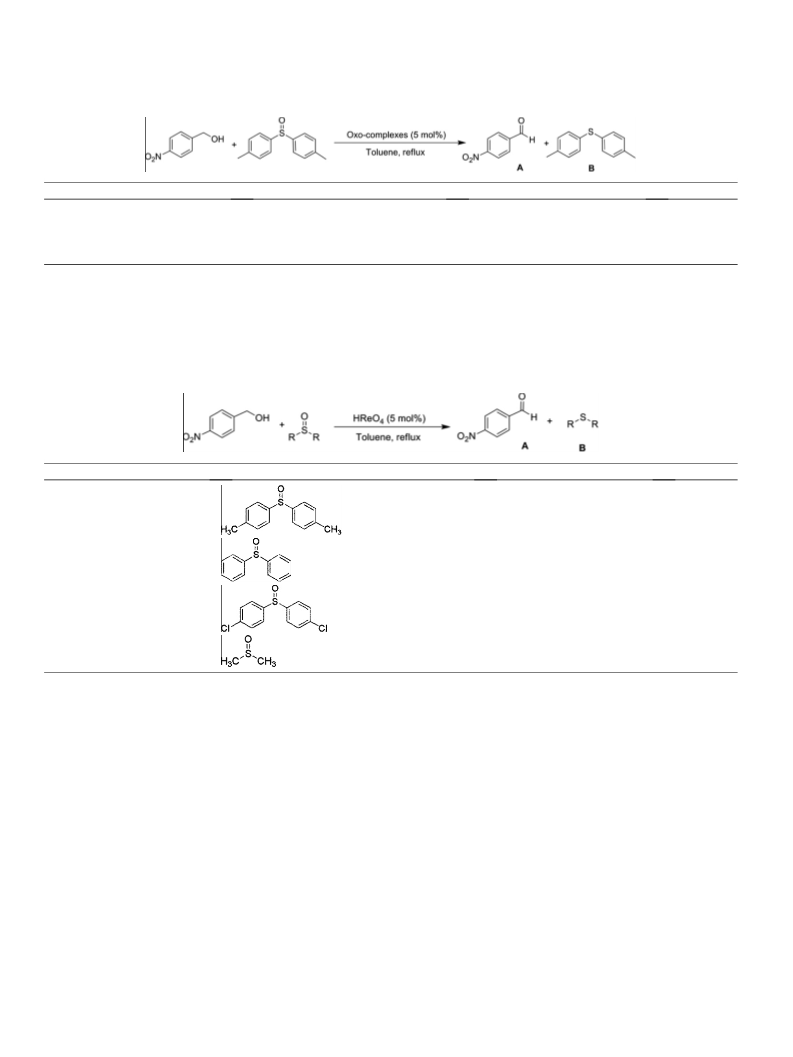
Initially we investigated the oxidation of 4-nitrobenzyl alcohol
4 2 2 2 2
with the oxo-complexes HReO , MoO (acac) , MoO Cl , VO(acac)2,
,2
and WO Cl via oxygen transfer from a sulfoxide. The reactions
2
2
were carried out in refluxing toluene under air atmosphere (Ta-
3
7 °C) and has an unpleasant smell; the electrophile oxalyl chlo-
ble 1), and the progress of the oxidations was monitored by thin
1
ride is moisture sensitive, toxic and its vapor is a powerful irritant,
particularly to the respiratory system; the activation of DMSO can
be violent and exothermic, and it must occur at low temperatures
layer chromatography and by H NMR. HReO
4
(5 mol %) proved
to be the best catalyst, affording 4-nitrobenzaldehyde in 99% yield
after 17 h (Table 1, entry 1). The oxo-molybdenum complexes
(
À60 °C). Several modifications on the Swern methodology have
MoO
(86–89%) (Table 1, entries 2 and 3). The oxo-vanadium complex
VO(acac) gave moderate yield (60%) of 4-nitrobenzaldehyde (Ta-
ble 1, entry 4), and finally WO Cl only produced low yield of the
product (Table 1, entry 5). In the reactions catalyzed by HReO
MoO Cl2, and MoO (acac) , 4-methylphenyl sulfide was isolated
in high yield (91–96%) (Table 1, entries 1–3).
The oxidation of 4-nitrobenzyl alcohol was also studied with
several sulfoxides as the oxidizing agent catalyzed by 5 mol % of
4
HReO in reflux of toluene under air atmosphere. Among all the
sulfoxides tested, the reactions with 4-methylphenyl sulfoxide, di-
phenyl sulfoxide, and 4-chlorophenyl sulfoxide produced the best
yields of 4-nitrobenzaldehyde (Table 2, entries 1–3). Good yields
of the sulfides were also isolated in the reactions with sulfoxides
like 4-methylphenyl sulfoxide, diphenyl sulfoxide, and 4-chloro-
phenyl sulfoxide (Table 2, entries 1–3). In the presence of DMSO,
4-nitrobenzyl alcohol was not oxidized (Table 2, entry 4).
2 2 2 2
Cl and MoO (acac) produced good yields of the aldehyde
been accomplished in order to overcome some of these disadvan-
tages.
Another traditional method for the oxidation of alcohols in-
volves the use of stoichiometric inorganic oxidants such as Cr(VI)
based reagents, which generate a large amount of heavy metal
3
–7
2
2
2
4
,
2
2
2
8
9,10
11–13
waste. Several oxo-vanadium,
oxo-molybdenum,
and
1
4
oxo-rhenium complexes have also proved to be efficient catalysts
for the oxidation of alcohols in the presence of molecular oxygen or
using hydroperoxide compounds as the oxidizing agent. Only a few
studies have also been reported for the oxidation of alcohols with
1
5–18
DMSO catalyzed by oxo-molybdenum or -rhenium complexes.
In continuation of our work about the use of oxo-complexes as
catalysts for oxidation/reduction reactions,1
9–27
in this communi-
⇑

 Sousa, Sara C. A.