4
52
M. Wu et al. / Electrochimica Acta 147 (2014) 451–459
−
2
−
5.0 A dm could be obtained. Antimony can be electrodeposited
rotating disk electrode experiments were performed on a platinum
rotating disk (ꢁ = 3 mm, Autolab).
The electrochemistry of antimony in ethylene glycol solutions
was studied using an electrochemical quartz crystal microbalance
(EQCM, Maxtek). The mass change per unit area (ꢂm) was deter-
mined from the Sauerbrey equation: [43]
from various kinds of electrolytes [30–38]. In the aqueous solu-
tions, Sb O is a commonly used antimony source. It dissolves as
2
3
+
antimonyl SbO in very acidic media (−2 < pH < 1). In the pH range
between 2 and 10, it forms undissociated HSbO which is virtu-
2
ally insoluble. In more alkaline solutions, Sb O dissolves upon
2
3
−
formation of the antimonite ion SbO2 [39,40]. To get hydrolyzed
antimony ions for electrodeposition, very acidic or alkaline solu-
tions were used in the literature for electrodeposition of antimony.
Electrodeposited antimony is chemically attacked in very acidic
ꢂf = −C ꢂm
(1)
f
where ꢁf is the frequency change and C is the sensitivity factor
f
−1
2
of the crystal, which was calibrated as 4020 Hz g m in ethylene
glycol solutions for a 5 MHz AT cut quartz crystal with a diameter
of 2.54 cm. The working electrode was Pt/Ti with a surface area of
media. Qiu et al. used an alkaline solution to dissolve Sb O to
2
3
deposit antimony [41]. However, the addition of a diaminourea
polymer was required to obtain smooth and uniform films. SbCl3
has a high solubility in ethylene glycol. Yamamoto et al. dissolved
2
1.37 cm . The calibration process followed the method described by
Gabrielli et al. [44]. A solution of 50 mM AgNO in ethylene glycol
3
8
.1 mol.% SbCl (∼1.58 M) in ethylene glycol to study the electrode-
3
was used for calibration, and depositions were done at constant
potentials. The sensitivity factor was calculated using the Sauerbrey
equation by assuming the current efficiency for silver deposition in
this solution is 100%.
position of antimony from ethylene glycol [42].
In our experiments, ethylene glycol was used as the solvent.
In order to have better control of film composition, smooth film
morphology and to be sure that the solution is less corrosive,
chloride-free solutions were prepared and used. In this paper,
we describe the electrochemical behavior of the electrodeposi-
tion of antimony, antimony-bismuth and bismuth-tellurium alloys.
All the electrochemical experiments were carried out with an
EG&G 273 potentiostat/galvanostat or an Autolab PGSTAT 302N
potentiostat. The elemental compositions of the deposited films
were determined by inductively coupled plasma optical emis-
sion spectroscopy (ICP-OES, Varian 720-ES apparatus). The water
contents of the solutions were measured using a Mettler-Toledo
DL39 Karl Fischer coulometer. The films were characterized by
scanning electron microscopy (SEM, Philips XL 30 FEG) using
secondary electrons (SE) and back-scattered electrons (BSE). The
antimony distribution in the multilayer was analyzed by wave-
length dispersive–electron probe microanalyzer (WD-EPMA, field
emission microprobe JXA-8530F). X-ray diffraction (XRD, Seifert
3003) was used to characterize the crystal structure of the deposits.
Thermoelectric Bi Te /(Bi Sbx) Te multilayers were electrode-
posited from a single bath using pulsed potential deposition.
2
3
1−x
2
3
2
. Experimental
Ethylene glycol (Alfa Aesar, 99%), SbCl3 (Alfa Aesar, >99%),
TeCl4 (Alfa Aesar, >99%), Bi(NO ) ·5H O (Alfa Aesar, >98%),
3 3
2
AgNO (Sigma-Aldrich, >99%), ferrocene (Acros Organics, 98%), fer-
3
rocenium hexafluorophosphate (Sigma-Aldrich, 97%) and LiNO3
(
Sigma-Aldrich, 99%) were used as received. Sb(NO3)3 solutions
3
. Results and discussion
in ethylene glycol were prepared by mixing equal volumes of a
solution of 0.4 M SbCl3 in ethylene glycol and a solution of 1.2 M
AgNO (a slight excess) in ethylene glycol, followed by removal of
3.1. Electrodeposition of antimony in ethylene glycol
3
the AgCl precipitate by centrifugation. The excess of silver(I) ions
was removed by electrodeposition of silver on a large surface area
platinum mesh working electrode, by applying a constant poten-
tial of −0.1 V (vs. Ag) and a platinum coil as the counter electrode.
Te(NO ) solutions were prepared according to a literature pro-
cedure [29]. After pre-electrolysis, the 0.2 M Sb(NO3)3 and 0.5 M
Te(NO3)4 ethylene glycol solutions were found to have a resid-
ual silver content of 4 ppm and 6 ppm, respectively (determined
by ICP-OES on a Varian 720-ES apparatus).
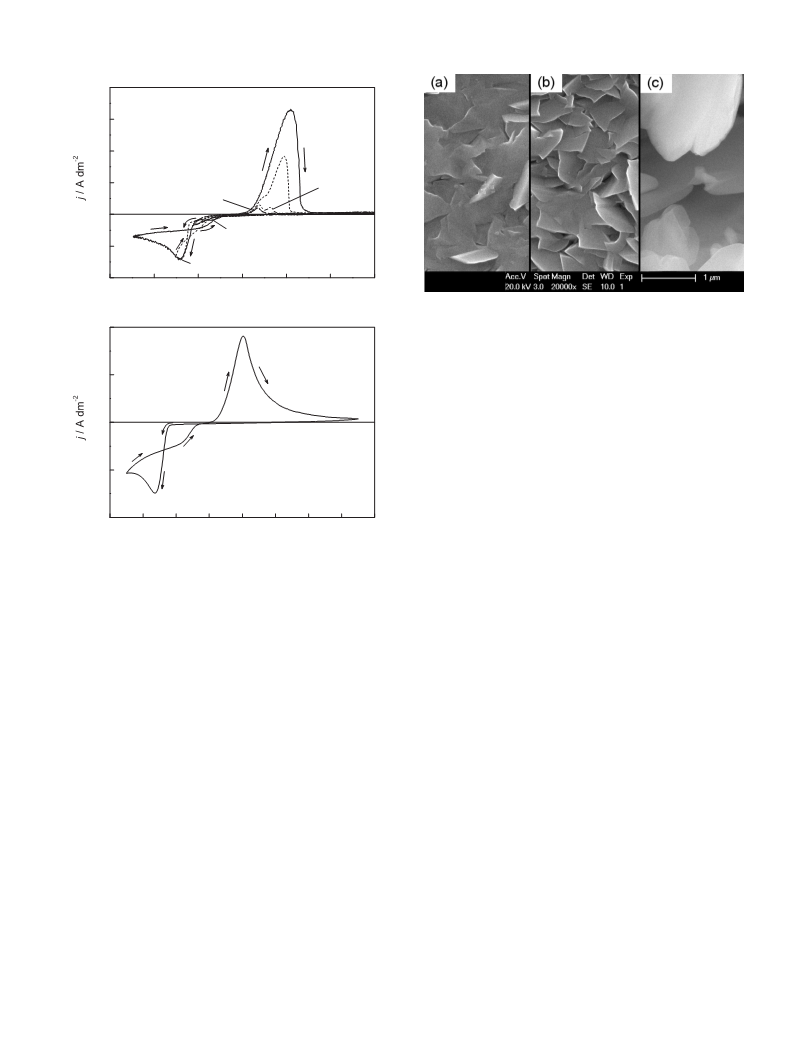
The cyclic voltammograms of a solution of 50 mM Sb(NO ) and
3
3
0
.5 M LiNO in ethylene glycol on a platinum working electrode are
3
shown in Fig. 1a. The CVs were stopped at different cathodic vertex
potentials to study the reduction reactions at different potentials.
There are two reduction waves on the cathodic scan. The first reduc-
tion wave r1 is at +0.12 V, and the main reduction peak r2 at −0.08 V
is assigned to the bulk reduction of Sb(III) ions to elemental anti-
mony. The reduction potential of antimony in ethylene glycol is
3
4
more negative than that in the acidic solutions (E0
= +0.21 V
+
SbO /Sb
All the experiments were carried out in a three-electrode set-up
on a lab bench. Ethylene glycol is hydrophilic and it absorbs water
from the environment, so all the solutions used contained 3–5%
of water. The reference electrode was a glass tube with a porous
ceramic plug in the bottom filled with an ethylene glycol solution
with equimolar (2 mM) ferrocene (Fc) and ferrocenium hexaflu-
vs. SHE), but more positive than its reduction potential in alka-
line solutions (E0
= −0.66 V vs. SHE) [45]. On the reverse
−
SbO /Sb
2
scan, a distinct stripping peak a1 was observed at a potential more
positive to the onset of the bulk stripping peak a2. However, on
the glassy carbon working electrode, only one reduction peak and
one oxidation peak could be observed which illustrates the effect
of substrate property on the pre-wave (Fig. 1b). A similar pre-
wave was observed during the deposition of antimony from the
dimethyl sulfoxide (DMSO) solution containing 20 mM SbCl3 by
Li and co-workers [46]. They claimed that the pre-peak was due
to the reduction of Sb(III) to Sb(II) and Sb(II) was further reduced
to elemental antimony at more negative potentials. However, the
pre-wave r1 in ethylene glycol solutions could not be assigned to
Sb(III) to Sb(II). This was proven by the wait-scan experiments: a
constant potential of +0.1 V, where only the first reduction reac-
tion would happen, was applied for 10 seconds, then the potential
scanned from +0.1 V to +1.1 V after waiting at open circuit poten-
tial for different times. An oxidation peak was always observed
at the potential scan, indicating the reduction product at the first
reduction peak was insoluble and did not diffuse away during the
+
+
orophosphate (Fc ) and 1 M LiNO . The potential of the Fc/Fc
3
electrode was compared with the Ag/AgCl/3 M KCl electrode in a
+
3
M KCl solution at room temperature. The potential of Fc/Fc elec-
trode was +0.29 V vs. Ag/AgCl/3 M KCl electrode. In this paper, all
the potentials were converted with respect to the standard hydro-
gen electrode (SHE). A platinum coil was used as counter electrode.
The films were deposited on gold-coated silicon wafers (silicon cov-
ered with 500 nm of silica, 10 nm of titanium and 100 nm of gold).
The wafers were cleaned by degreasing in an alkaline cleaner (P3-
◦
RST Henkel) at 70 C for 10 min, then rinsed with deionized water
and immersed in a 10 wt.% HCl solution for 1 min, followed by rins-
ing with deionized water and absolute ethanol, and finally dried
in a stream of warm air. The working electrode for cyclic voltam-
metry and for linear scan voltammetry experiments was a polished
®
platinum disk (diameter ꢁ = 1 mm) embedded in EpoFix resin. The

 Wu, Minxian