-TTTAAA-, and SmaI, that recognizes the base sequence
-CCCGGG-, were chosen and their ability to cleave ruthenated
plasmid pUC9 samples was tested. This analysis was performed
on the concentrations r = 0.1 and r = 0.3 and the results
were compared with the cleavage of a fresh sample of plasmid
pUC9 and samples at the same concentrations without enzyme
treatment. Testing the inhibition of the enzyme SmaI, a weak
band was observed (lane bꢀ, r = 0.1) in the same position as when
no restriction enzyme was used (lane bꢀꢀ, r = 0.1). This obser-
vation is consistent with a binding of the complex [Ru(terpy)(4-
CO2H-4ꢀ-Mebpy-Gly-L-His-L-LysCONH2)Cl](PF6) to the bases
guanine and cytosine and consequently the enzyme can no
longer recognize the restriction site. Inhibition of the enzyme
by the ruthenium complex can be excluded due to the observed
cleavage of the DNA in other uncomplexed sites in low
ratio (Fig. 7). The cleavage of the plasmid pUC9 samples
using the enzyme DraI, was performed and no inhibition of
the enzyme action was observed. These results suggested a
preference of the complex [Ru(terpy)(4-CO2H-4ꢀ-Mebpy-Gly-L-
His-L-LysCONH2)Cl](PF6) for the bases guanine and cytosine
over the bases thymine and adenine.
3 K. D. Copeland, M. P. Fitzsimons, R. P. Houser and J. K. Barton,
Biochemistry, 2002, 41, 343.
4 H. A. Wagenknecht, E. D. A. Stemp and J. K. Barton, J. Am. Chem.
Soc., 2000, 122, 1.
5 N. Y. Sardesai, K. Zimmermann and J. K. Barton, J. Am. Chem. Soc.,
1994, 116, 7502.
6 N. Y. Sardesai, S. C. Lin, K. Zimmermann and J. K. Barton,
Bioconjugate Chem., 1995, 6, 302.
7 C. A. Hastings and J. K. Barton, Biochemistry, 1999, 38, 10042.
8 A. Myari, N. Hadjiliadis and A. Garoufis, Eur. J. Inorg. Chem., 2004,
1427.
9 M. S. Robillard, A. Valentijn, N. J. Meeuwenoord, G. A. van der
Marel, J. H. van Boom and J. Reedijk, Angew. Chem., Int. Ed., 2000,
39, 3096.
10 M. S. Robillard, M. Bacac, H. van den Elst, A. Flamigni, G. A. van
der Marel, J. H. van Boom and J. Reedijk, J. Comb. Chem., 2003, 5,
821.
11 S. van Zutphen, M. S. Robillard, G. A. van der Marel, H. S.
Overkleeft, H. den Dulk, J. Brouwer and J. Reedijk, Chem. Commun.,
2003, 634.
12 R. C. Lasey, S. S. Banerji and M. Y. Ogawa, Inorg. Chim. Acta, 2000,
300, 822.
13 A. Fedorova and M. Y. Ogawa, Bioconjugate Chem., 2002, 13, 150.
14 A. Fedorova, A. Chaudhari and M. Y. Ogawa, J. Am. Chem. Soc.,
2003, 125, 357.
15 A. Y. Kornilova, J. F. Wishart, W. Z. Xiao, R. C. Lasey, A. Fedorova,
Y. K. Shin and M. Y. Ogawa, J. Am. Chem. Soc., 2000, 122, 7999.
16 R. C. Lasey, L. Liu, L. Zang and M. Y. Ogawa, Biochemistry, 2003,
42, 3904.
17 L. Liu, J. Hong and M. Y. Ogawa, J. Am. Chem. Soc., 2004, 126, 50.
18 O. Novakova, J. Kasparkova, O. Vrana, P. M. Vanvliet, J. Reedijk
and V. Brabec, Biochemistry, 1995, 34, 12369.
19 A. Catte, F. C. Marincola, M. Casu, G. Saba and A. Lai, J. Biomol.
Struct. Dyn., 2002, 20, 99.
20 B. P. Sullivan, J. M. Calvert and T. J. Meyer, Inorg. Chem., 1980, 19,
1404.
21 E. Atherton and R. C. Sheppard, Solid Phase Peptide Synthesis: A
Practical Approach, IRL, Oxford, UK, 1989, p. 87.
22 C. M. Hartshorn, K. A. Maxwell, P. S. White, J. M. DeSimone and
T. J. Meyer, Inorg. Chem., 2001, 40, 601.
23 S. M. Zakeeruddin, M. K. Nazeeruddin, P. Pechy, F. P. Rotzinger,
R. Humphry-Baker, K. Kalyanasundaram, M. Gratzel, V. Shklover
and T. Haibach, Inorg. Chem., 1997, 36, 5937.
24 J. P. Macquet and J. L. Butour, Eur. J. Biochem., 1978, 83, 375.
25 P. M. Vanvliet, J. G. Haasnoot and J. Reedijk, Inorg. Chem., 1994,
33, 1934.
26 E. Gallori, C. Vettori, E. Alessio, F. G. Vilchez, R. Vilaplana, P.
Orioli, A. Casini and L. Messori, Arch. Biochem. Biophys., 2000,
376, 156.
4
Conclusions
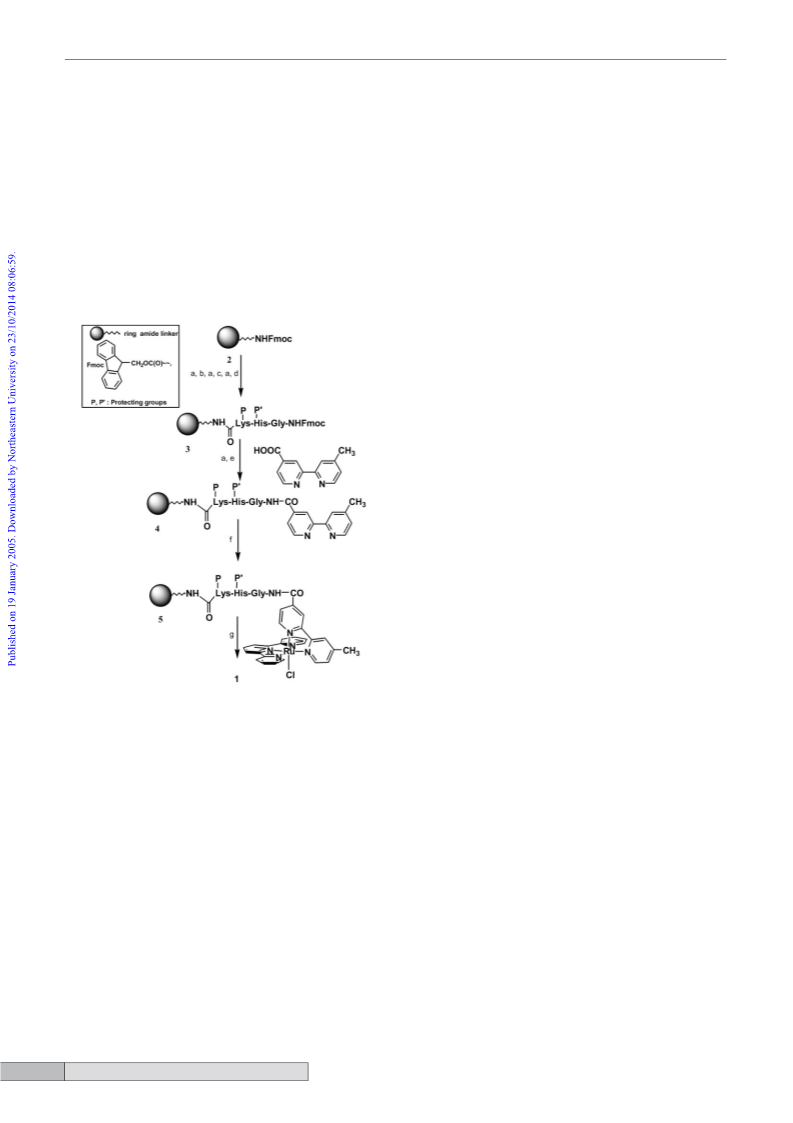
A generally applicable method to synthesize chloro(poly-
pyridyl)ruthenium conjugated peptide complexes via solid-
phase strategy is described herein for the first time. The
method is used to synthesize the complex [Ru(terpy)(4-CO2H-
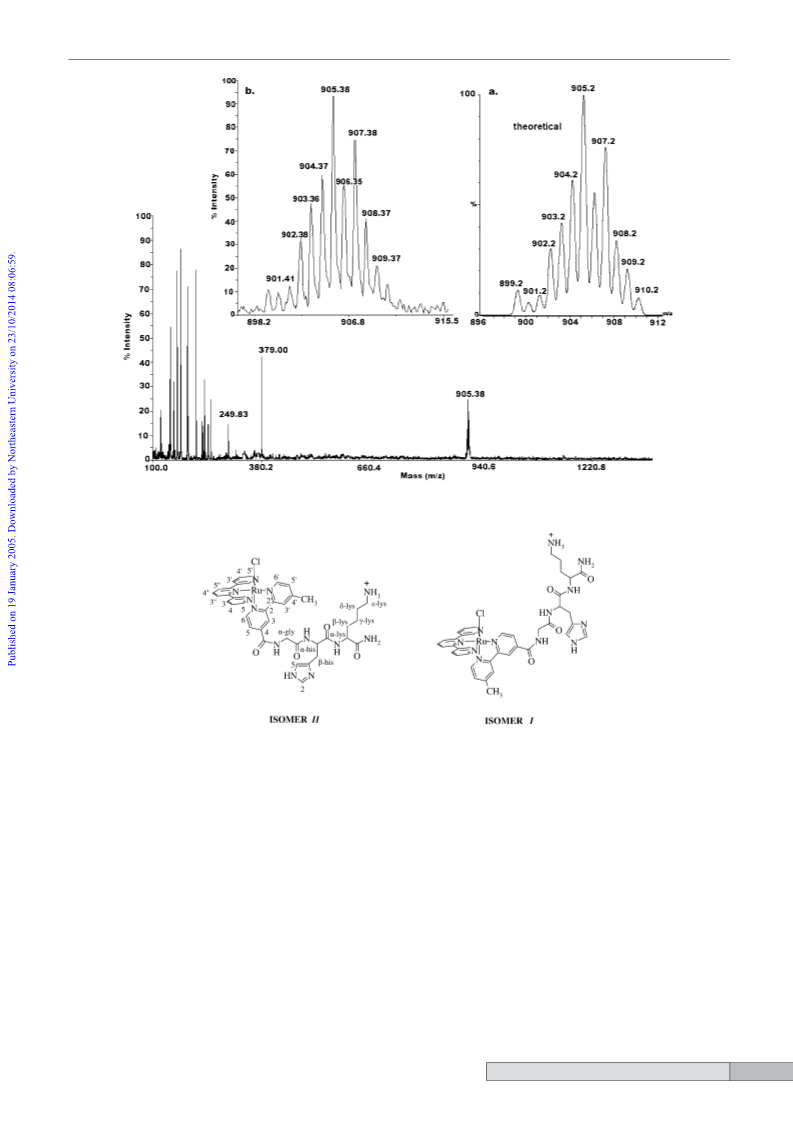
4ꢀ-Mebpy-Gly-L-His-L-LysCONH2)Cl](PF6) as a mixture of
two positional isomers. Even though, the separation of the
isomers was only partially achieved chromatographically the
isomers were assigned by NMR spectroscopy. The interac-
tions of the complex [Ru(terpy)(4-CO2H-4ꢀ-Mebpy-Gly-L-His-
L-LysCONH2)Cl](PF6) with CT-DNA and plasmid DNA, were
studied with various spectroscopic techniques showing that
(i) the complex coordinatively binds to DNA preferring the
bases guanine and cytosine over the bases thymine and adenine
after hydrolysis of the coordinated chloride, (ii) electrostatic
interactions between the complex cation and the polyanionic
DNA chain assist this binding (iii) only in the case of isomer I
the peptide interacts further with DNA as evidenced from 31P
NMR spectroscopy, (iv) DNA unwinding occurs in all cases
with high binding ratio (Ru/base) values (r > 0.3).
27 M. J. Clarke, B. Jansen, K. A. Marx and R. Kruger, Inorg. Chim.
Acta, 1986, 124, 13.
Acknowledgements
28 K. Akdi, R. A. Vilaplana, S. Kamah, J. A. R. Navarro, J. M. Salas
and F. Gonzalez-Vilchez, J. Inorg. Biochem., 2002, 90, 51.
29 D. G. Gorenstein, Annu. Rev. Biophys. Bioeng., 1981, 10, 355.
30 W. D. Wilson, B. L. Heyl, R. Reddy and L. G. Marzilli, Diamagnetic
Metal Species that Induce Pronounced Changes in the P-31 NMR-
Spectrum of DNA, 1982.
This work was supported by a Marie Curie Training Fellowship
from the EU in the 5th Framework programme (MEDICINOR;
Grant No. HPMT-CT-2000-00192), allowing one author (K. K.)
to spend time at the LIC in Leiden to perform most of the
experimental work. Also by a research programme of the Greek
General Secretariat of Research and Technology (PENED
2001). Andrea Catte is kindly acknowledged for his help with
the sonication of the CT DNA.
31 G. Mallet, S. Ansiss and D. Vasilescu, J. Biomol. Struct. Dyn., 1998,
16, 21.
32 R. T. Simpson and H. Shindo, Nucleic Acids Res., 1979, 7, 481.
33 J. Kypr, V. Sklenar and M. Vorlickova, Biopolymers, 1986, 25, 1803.
34 D. G. Gorenstein, Method Enzymol., 1992, 211, 254.
35 L. Ghys, M. Biesemans, M. Gielen, A. Garoufis, N. Hadjiliadis, R.
Willem and J. C. Martins, Eur. J. Inorg. Chem., 2000, 513.
36 Z. Yang, T. Bakas, A. Sanchez-Diaz, C. Charalampopoulos, J.
Tsangaris and N. Hadjiliadis, J. Inorg. Biochem., 1998, 72, 133.
37 M. Mottes, G. Grandi, V. Sgaramella, U. Canosi, G. Morelli and
T. A. Trautner, Mol. Gen. Genet., 1979, 174, 281.
38 S. E. Sherman and S. J. Lippard, Chem. Rev., 1987, 87, 1153.
References
1 B. M. Peek, G. T. Ross, S. W. Edwards, G. J. Meyer, T. J. Meyer and
B. W. Erickson, Int. J. Pept. Protein Res., 1991, 38, 114.
2 K. D. Copeland, A. M. K. Lueras, E. D. A. Stemp and J. K. Barton,
Biochemistry, 2002, 41, 12785.
7 3 4
D a l t o n T r a n s . , 2 0 0 5 , 7 2 8 – 7 3 4

 Karidi, Konstantina