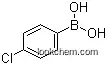



1679-18-1Relevant academic research and scientific papers
SYNTHESIS OF ARYLBORONIC ACIDS VIA THE REACTION OF BORANE WITH ARYLMAGNESIUM HALIDES
Kabalka, George W.,Sastry, Usha,Sastry, K.A.R.,Knapp, Furn F.,Srivastava, Prem C.
, p. 269 - 274 (1983)
The reaction of borane complexes with arylmagnesium halides produces the corresponding arylborohydrides in high yield.The arylborohydrides are readily hydrolyzed to the arylboronic acids.The syntheses are conveniently carried out in one pot.The reaction mechanism was clarified via a boron-11 NMR study.
Aryl boronic acid preparation method
-
Paragraph 0033-0036; 0041, (2020/01/25)
The invention belongs to the technical field of fine chemical engineering, and relates to an aryl boronic acid preparation method. In the prior art, aryl boronic acid as a novel safe and environmentally-friendly arylation reagent is widely used in scientific research and production of various fine chemicals containing aryl structures in the fields of medicines, pesticides, advanced materials and the like; and the aryl boronic acid compound preparation method reported in the disclosed literature has problems of harsh reaction conditions and high cost. A purpose of the invention is to provide amethod, wherein an aryl boron compound is formed by carrying out a reaction on a Grignard reagent and trialkyl borate under mild conditions, the composition of the aryl boron compound is converted from the main component diaryl borate into the main component aryl borate, and the aryl borate is hydrolyzed to obtain aryl boric acid, so that the preparation cost of the acyl aryl boric acid compound can be remarkably reduced, and the method has good practical application prospect.
Preparation method of monohalogenated phenylboronic acid
-
Paragraph 0080-0083, (2020/09/20)
The invention relates to the technical field of chemical synthesis, and particularly discloses a preparation method of monohalogenated phenylboronic acid. The preparation method comprises the following steps of: by taking dihalogenated benzene as a raw material and a mixture of lithium salt and alkaline ionic liquid as a catalyst, carrying out Grignard exchange with R1MgCl to generate monohalogenated phenyl magnesium chloride, reacting with B (OR) 3 to generate monohalogenated phenyl borate, and hydrolyzing under acidic conditions to obtain monohalogenated phenylboronic acid. The HPLC (High Performance Liquid Chromatography) content of the monohalogenated phenylboronic acid prepared by the method is greater than 99.5%; the total yield of the product is greater than 80%, the contents of monohalogenated phenylboronic acid and phenyldiboronic acid impurities of another halogen are both less than 0.003%, the requirements of modern fine chemical synthesis are completely met, the raw materials are easily available, the operation is simple, the safety is high, and the industrial production of monohalogenated phenylboronic acid is realized.
Synthesis method of P-chlorophenylboronic acid
-
Paragraph 0022-0029, (2020/04/22)
The invention belongs to the technical field of organic synthesis, and particularly relates to a synthesis method of p-chlorophenylboronic acid, which comprises the following steps: carrying out Friedel-Crafts reaction between chlorobenzene used as a raw material and boron trichloride under the action of a catalyst to obtain dichloro(4-chlorophenyl) borane, and carrying out acidic hydrolysis to obtain p-chlorophenylboronic acid. According to the method, p-chlorophenylboronic acid is synthesized by taking chlorobenzene as a raw material through a Friedel-Crafts reaction, and the method has theadvantages of novel synthesis route, simple and practical operation, easily available raw materials, low cost, environmental friendliness, and the like.
Pd- And Ni-Based Systems for the Catalytic Borylation of Aryl (Pseudo)halides with B2(OH)4
Munteanu, Charissa,Spiller, Taylor E.,Qiu, Jun,Delmonte, Albert J.,Wisniewski, Steven R.,Simmons, Eric M.,Frantz, Doug E.
, p. 10334 - 10349 (2020/09/18)
Despite recent advancements in metal-catalyzed borylations of aryl (pseudo)halides, there is a continuing need to develop robust methods to access both early-stage and late-stage organoboron intermediates amendable for further functionalization. In particular, the development of general catalytic systems that operate under mild reaction conditions across a broad range of electrophilic partners remains elusive. Herein, we report the development and application of three catalytic systems (two Pd-based and one Ni-based) for the direct borylation of aryl (pseudo)halides using tetrahydroxydiboron (B2(OH)4). For the Pd-based catalyst systems, we have identified general reaction conditions that allow for the sequestration of halide ions through simple precipitation that results in catalyst loadings as low as 0.01 mol % (100 ppm) and reaction temperatures as low as room temperature. We also describe a complementary Ni-based catalyst system that employs simple unligated Ni(II) salts as an inexpensive alternative to the Pd-based systems for the borylation of aryl (pseudo)halides. Extrapolation of all three systems to a one-pot tandem borylation/Suzuki-Miyaura cross-coupling is also demonstrated on advanced intermediates and drug substances.
Preparation method of 4-chlorophenylboronic acid
-
Paragraph 0029-0030, (2019/08/07)
The invention belongs to the technical field of organic synthesis and particularly relates to a preparation method of 4-chlorophenylboronic acid. The preparation method has the advantages that reaction conditions are optimized, the used raw materials are economical, low raw material cost is achieved, the mixed solvent of toluene and tetrahydrofuran is used to replace a single tetrahydrofuran solvent, p-dichlorobenzene replaces p-chlorobromobenzene to serve as the main raw material of Grignard reaction, discharge in water is achieved through condensation reaction with trimethyl borate or tributyl borate and post-treatment, raw material and solvent costs are saved greatly, yield is increased, and the preparation method is high in yield, low in cost, evident in competitive advantage and convenient to achieve industrial production.
Magnesium promoted autocatalytic dehydrogenation of amine borane complexes: A reliable, non-cryogenic, scalable access to boronic acids
Marciasini, Ludovic D.,Richard, Jimmy,Cacciuttolo, Bastien,Sartori, Guillaume,Birepinte, Melodie,Chabaud, Laurent,Pinet, Sandra,Pucheault, Mathieu
, p. 164 - 171 (2018/12/05)
Owing to the unusual reactivity of dialkylamine-borane complexes, a methodology was developed to simply access boronic acids. The intrinsic instability of magnesium aminoborohydride was tweaked into a tandem dehydrogenation borylation sequence. Proceeding via an autocatalytic cycle, amineborane dehydrogenation was induced by a variety of Grignard reagents. Overall, addition of the organomagnesium species onto specially designed dialkylamine-borane complexes led to a variety of boronic acids in high yields. In addition, the reaction can be performed under Barbier conditions, on a large scale.
Method for preparing chlorophenylboronic acid
-
, (2018/11/03)
The invention discloses a method for preparing chlorophenylboronic acid. The method has the advantages that existing Grignard reagent processes are improved, Grignard reaction and substitution reaction are combined with each other and are carried out at a step, accordingly, ultralow-temperature control can be omitted, energy consumption can be obviously reduced, the operation difficulty can be obviously lowered, byproducts can be reduced, and the yield of target products can be increased.
Copper-Catalyzed Monoorganylation of Trialkyl Borates with Functionalized Organozinc Pivalates
Fu, Ying,Gou, Bei-Lei,Shi, Chun-Zhao,Du, Zhengyin,Shen, Tong
, p. 4253 - 4257 (2018/09/18)
Organozinc pivalates, a recently developed air- and moisture-stable organozinc species, were found for the first time as excellent organometallic species in the monoorganylation of trialkyl borates whereby boronic acids were prepared in high yields. The significant advantage of organozinc pivalates over another previously employed organometallic reagents, e. g., organolithium reagents, Grignard reagents and organozinc halides, is that the generation of multiorganylation byproducts such as borinic acids and trialkylboranes were completely suppressed. Additionally, the in situ generated boronates could be directly arranged into Suzuki-Miyaura type cross-coupling reactions to produce biaryls in high yields.
Efficient Synthesis of Aryl Boronates via Cobalt-Catalyzed Borylation of Aryl Chlorides and Bromides
Verma, Piyush Kumar,Mandal, Souvik,Geetharani
, p. 4049 - 4054 (2018/05/22)
An efficient catalytic system based on a Co(II)-NHC precursor has been developed for the cross coupling of bis(pinacolato)diboron with aryl halides including aryl chlorides, affording the aryl boronates in good to excellent yields. A wide range of functional groups are tolerated under mild reaction conditions. The reaction shows excellent chemoselectivity for bromide over chloride. Preliminary mechanistic investigations show that the catalytic cycle may rely on a cobalt(I)-(III) redox couple.


